I just arrived back in Rishikesh after a two week trekking sojourn to the pilgrimage sites of Kedarnath, Hemkund Sahib (and the Valley of Flowers), and Badrinath.
I spent the day praying... not in the enlightenment sort of way, but rather for my safety! I'm not usually sqeamish about bus rides, but have to say the roads in the Uttarkhand mountains are the most dangerous I have been on... more so than the 40 hour ride from Manali to Leh, Ladakh. The Uttarkhand roads lay or try to lay upon very steep mountainsides.
In the last two weeks I spent three or four 10-12 hour days on these roads. One day I was amused as we passed a sign that said "Warning: Landslide Area!"... this was after about 8 hours of traveling upon roads covered with landslides. I think that was the same day that I saw a sign saying the area was being monitored and measured for landslide activity. I felt better knowing that my death would be counted should we get swiped out by a landslide.
Over the last weeks, a line in Aaron K's book Between a Rock and Hard Place kept coming to my mind: Geologic time does not stop. He means that the Earth keeps plodding away in Her changes. Boulders fall. Earthquakes, floods, and ice ages happen. No matter where we and our little selves happen to be. We tend to live in denial of that. Memphis is on a major fault line which either Lewis or Clark happened to be around during the last major earthquake in that region. The alluvial soil rose up in waves! I pondered that alot as I rode along roads that could slide away, or be covered in boulders as big as cars in the flash of a heartbeat. Really all we have is our faith and prayer and intention. Doesn't do much good to worry about such things.
Today I was fortunate enough to get the "death seat"... my assigned seat was in the cab of the bus... next to the front window on a bench that is perpendicular to the direction of travel. If I were to look straight ahead, I would be staring at the driver. I looked over my left shoulder to focus on the horizon so as not to get motion sickness. There were six others besides myself and the bus driver in the "cab" of the bus. Three of us sat on the bench seat, backs to the side window. Three others crammed onto a platform extending from the console. One fellow sat in lotus position for several hours!
I faithfully kept my eyes on the horizon, occasionally glancing over the sheer dropoffs, while the man next to me vomited. He was joined by a woman in the cab in vomiting fever at one point. I was happily upwind!
The driver seemed to be going too fast. These are not normal roads... it takes 10-12 hours to go 250 km or so. Often the roads are barely wide enough for two vehicles to pass. On one side, there may be rock outcrops that threaten to decapitate vehicles, and sheer dropoffs on the other side. Unlike the road to Ladakh, much of the road here was paved, where it wasn't washed out or covered by landslides. I think the paving made it worse because it allows vehicles to go faster.
When I got my ticket yesterday, I thought the front seat would be good. On my way to Kedarnath, I was in the back seat which serves as a catapult to pummel ones behind. The front seat wasn't much better. I spent a good deal of my time trying to perfect my posture so as not to increase the growing pain in my back. And then, in the front seat, I got to see all the action! The near misses with other vehicles. At one point the driver nearly ran right into a lorry (the mainstay of Indian road transport, lorries are rather like large dumptrucks, bright ornamented and painted). We skidded to a halt about 5 feet in front of the oncoming truck.
I wasn't sure whether to wish the driver was on or off drugs! I rather wished I was on some! I kept to my prayers... to live healthily into my 90s... to arrive intact to Rishikesh. I tried to send the driver psychic images of love and peace and no hurry. Meanwhile the Border Road Organizations signs tried to do their part: Better Late than Never; Hurry, Burry, Spoils the Curry; Be Gentle on my Curves; etc... The BRO signs are amusing parts of the border/mountain roads with quaint antedotes, often misspelled. One sign said "Mobile Phone Off; Sent Bell On!" I suppose they meant seat belt!
It didn't matter much because either our driver didn't read English, or didn't care. We careened around the corners and I could only pray that he knew the road well (he seemed to know the maximum speed to take the curves for sure!) and that because this is India and things work differently here... we would encounter oncoming vehicles at just the right spaces... where we could pass each other. I realized at one point that at least if we all died, since we had been to the Holy Badrinath Temple, all our sins and karma would be clear! The Hindu idea is that then you are spared another incarnation. I'm not sure if I want to be spared another incarnation, but maybe spared another bus ride like this!
Last week on one bus, we passed a truck with about 5 inches of clearance. In many ways, I think these mountain drivers are the best in the world. They know their vehicles to the inch. All the trucks and buses have conductors who play an active role in monitoring the vehicles edge. They work long hours. We left at 6:30 am this morning and it would likely be 8pm before the bus finished it's route. I couldn't imagine being the driver. There wasn't more than 100 yards of road today that was straight... and even then it was likely in a village where any number of people, cows, bikes, etc... might be on the road.
But it is different here. Passing is not an ego based thing. We pass them. They pass us on the next curve. Passing is part of life. There is no such thing as defensive driving here either. You just go along as fast as you can. But there is an awareness that pedestrians, bikes, cows, etc will be on the road. In contrast, in the US there seems to be ego and upset about passing, and in many places anything that is not a motor vehicle is considered a dire obstacle to the progress of the supreme automobile. In India, lanes do not really exist. You keep to the left. The bigger vehicle usually demands the right of way, but will sometimes back down. It's kind of like a game of chicken with a tiny bit of courtesy and common sense.
Towards the end of the day, we skidded to a halt with my seat seeming to hang over the edge of the cliff. It didn't seem to phase the driver much. By that point, it barely phased me. I knew my journey was nearly over and I was hopeful that since we had made it that far, we would reach our destinations.
I was grateful to get off the bus. Next time I think I will be happy with a seat in the back where I can't see all the action. The leg room was just as bad in the front... Asian buses are not built for larger people and often my knees are crammed against the seat in front. Today, they were crammed against the console.
I think I reached a few moments of lightheartedness in my prayers today, but overall I was tired. As I tried to remember how to walk from where the bus dropped me off, I ran into a manager from the guest house where I'd stayed before. He escorted me to the guesthouse... the staff and owner were happy to see me... it was like coming home to family.
Now it's time for bed!
Saturday, October 06, 2007


The Trouble with Rubbish
The trouble with rubbish in India is what to do with it. For any environmentally conscious traveler, India proves aggravating. It can be humorous at times. In a Varanasi internet cafe, a tourist holding a piece of garbage looked around diligently for a rubbish bin, and finally asked the shopkeeper. He took the piece of garbage and threw it out the door into the alleyway. For Indians, the place for garbage is down. Get rid of it as soon as you are finished with it. In the city of Varanasi, it's funny because the garbage seemingly disappears. A wallah (worker) comes along with a hand cart and carts the rubbish away from the back alleys. I'm not sure where he takes it out of the back alleyways. Perhaps it gets tossed in the Holy Ganga. Perhaps it gets taken to some of the piles of rotting rubbish I saw on one of the main streets. I even saw what seemed to be a landfill of sorts along the river. Along the bigger streets there, the practice seemed to be to put rubbish in the road, let the cows pick through it, and light it afire. Most everyplace in India seems plagued with toxic fumes from rubbish fires. Plastics even get thrown into cooking fires! Yum!
Two years ago in Rishikesh, some travelers told how their guest house had signs proclaiming "Throw your rubbish in the bins." One evening they saw the housekeeper from the guest house emptying the rubbish bins into the river.
In Varanasi, one young man suggested going to Bangalore, where not only do they have rubbish bins, but they know how to use them!
In several places like Sikkim, Ladakh, and Badrinath, I've seen signs saying "ban plastic bags". A brilliant idea, except that even if the plastic shopping bags are not used, there is no end to the plastic packets of candy, tobacco, soaps, etc... that manufactured items are sold in. Enterprising capitalists have realized that they can package most any consumable in a small dose and pedal it for a few ruppees to millions of Indians. Laundry detergent, candies, chewing tobacco, shampoo... you name it... can be purchased in a single use/dose sachet. And the wrapper ends up on the ground.
It's ashame. On the other side there is some marvelous recycling and compostable wrappers being used. Independent food vendors make and sell such things as popcorn, butter cookies, snacks, etc and fold up little bags out of newspaper. It's so ingenious! And the paper at least will rot somewhat quickly on the ground. Sometimes unkilned clay vessels are used for tea, yogurt, etc. And the used vessel can just be thrown on the ground. Many times shopkeepers will wrap your purchase in newspaper. It's quite brilliant. Unfortunately, it's slowly disappearing with the marketing of plastic cups, containers, bags, etc.
Last week I was hiking near Badrinath and ran into some locals and sat with them as we enjoyed our packets of manufactured biscuits (sweet cookies/crackers). They threw their wrapper on the ground. I put mine in my pocket to take it to my guesthouse, where conspicuously there was no rubbish pail in my room. I laughed at my predicament. I realized that my small pile of rubbish in my room would likely end up in the river. Was it better to leave the biscuit wrapper on the mountain trail? I considered, that I could take it back to Rishikesh with me. Where it would just end up further downstream in the same river. I fantasized about taking it to Delhi, where maybe there was some sort of proper landfill... as if that is much better. Or even carting it back to the U.S. on a fossil fuel spewing jet, to be laid to rest in an potentially even more proper landfill. I left my rubbish in the guesthouse in Badrinath. And realized the best policy would be not to buy anything wrapped in rubbish.
Two years ago in Rishikesh, some travelers told how their guest house had signs proclaiming "Throw your rubbish in the bins." One evening they saw the housekeeper from the guest house emptying the rubbish bins into the river.
In Varanasi, one young man suggested going to Bangalore, where not only do they have rubbish bins, but they know how to use them!
In several places like Sikkim, Ladakh, and Badrinath, I've seen signs saying "ban plastic bags". A brilliant idea, except that even if the plastic shopping bags are not used, there is no end to the plastic packets of candy, tobacco, soaps, etc... that manufactured items are sold in. Enterprising capitalists have realized that they can package most any consumable in a small dose and pedal it for a few ruppees to millions of Indians. Laundry detergent, candies, chewing tobacco, shampoo... you name it... can be purchased in a single use/dose sachet. And the wrapper ends up on the ground.
It's ashame. On the other side there is some marvelous recycling and compostable wrappers being used. Independent food vendors make and sell such things as popcorn, butter cookies, snacks, etc and fold up little bags out of newspaper. It's so ingenious! And the paper at least will rot somewhat quickly on the ground. Sometimes unkilned clay vessels are used for tea, yogurt, etc. And the used vessel can just be thrown on the ground. Many times shopkeepers will wrap your purchase in newspaper. It's quite brilliant. Unfortunately, it's slowly disappearing with the marketing of plastic cups, containers, bags, etc.
Last week I was hiking near Badrinath and ran into some locals and sat with them as we enjoyed our packets of manufactured biscuits (sweet cookies/crackers). They threw their wrapper on the ground. I put mine in my pocket to take it to my guesthouse, where conspicuously there was no rubbish pail in my room. I laughed at my predicament. I realized that my small pile of rubbish in my room would likely end up in the river. Was it better to leave the biscuit wrapper on the mountain trail? I considered, that I could take it back to Rishikesh with me. Where it would just end up further downstream in the same river. I fantasized about taking it to Delhi, where maybe there was some sort of proper landfill... as if that is much better. Or even carting it back to the U.S. on a fossil fuel spewing jet, to be laid to rest in an potentially even more proper landfill. I left my rubbish in the guesthouse in Badrinath. And realized the best policy would be not to buy anything wrapped in rubbish.
Uttarkhand Pilgrimage Treks: Kedarnath
23 Sep, 2007. No seat on the local bus I caught from Rishikesh. Standing, holding on to the ceiling rails as the bus swerved around the mountain curves... landslides, traffic... my muscles and stamina were being tested. It was hot, dusty, and cramped. I nearly bailed out and returned to Rishikesh where I'd been staying about a week... primarily exhausted from my 24 hour journey from Varanasi. My Reiki colleaugue put met to work seeing clients and I never got a day of rest. But, I persevered on the bus and after an hour and a half I got a seat... the very back seat. Not very comfortable because every bump in the road, and there were many, slapped my butt and sent me flying. Back seats are always the bumpiest! Later I was glad I stuck it out. The mountains soothed my soul... but initially, I wondered if I hadn't been better off staying in Rishikesh.
The bus stopped about 6 pm in a small town in the mountains. I didn't know where I was. I thought we were just taking a dinner break as I didn't expect to reach my destination until 8pm. Finally the conductor managed to convey to me that the bus was going no farther! And I would have to catch another bus in the morning. I tried several places to get a room, but all were booked. As I looked for a room, I learned that I was in RudraPrayag, which was my destination... we had arrived two hours early because the roads were "good"! You could have fooled me! Bumpy, full of traffic, and blocked by landslides, the roads didn't seem good to me! I would later find out on other bus trips in the near mountains, that we were lucky. Sometimes landslides caused delays of several hours or more!
Surprisingly, in the congested transport hub town, in the guesthouse I finally found a room in, I got a good nights sleep in spite of the noise. I found a 7am bus to Garikund (1982 m/6503 ft), the starting point for the trek to Kedarnath. Arrived four hours later, on schedule. I took a bath in the public hot springs... like small swimming pool in the center of town, fed by natural, hot, sulphur water. Then I started my trek. It felt very good. Amazingly good. I remembered how much I love the mountains, and I realized it had been a long time since I'd been any place near quiet. I'd been in the sweltering, noisy plains of India for several months. It was only a 8 km (5 mile) hike to Rambara (2591 m/8501 ft), half way up the mountain, where I planned to spend the night. I was walking too fast. I didn't want to pass the scenery so fast, plus I wanted to go easy on my body which hadn't hiked for a while, and also go slowly on the elevation gain for acclimitization purposes. So I took off my sandals and went barefoot on the nice smooth stone path. I savoured the scenery.
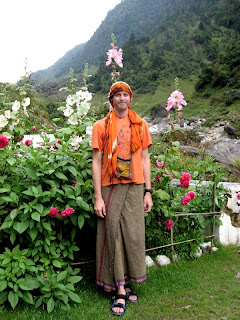
I practiced the "Christ walk" an old hippie had told me about in California. He said he'd met a guy in the Summer of Love whose "trip" was the "Christ walk"... it meant to walk barefoot, putting the toes down first, before letting the heal come down. Walking this way is easier on your joints, and allows you to sample a footstep before committing to it... useful in case of harsh ground. And the idea was that it gets you in touch with the Earth.. the Goddess... in some spiritualities. So I practised my Christ walk and remembered a chant from Rainbow Gatherings "Mother I feel you under my feet... Mother I feel your heart beat... Heya heya heya, ya haya haya ho, haya haya haya ha-ya ho!"... and no, this doesn't mean stepping on your biological Mother! It's about the Earth Mother! It felt good and got me in touch with the Reiki/earth energies. It slowed me down. It allowed me to enjoy each step and look around. I felt myself flow into a meditative bliss. I beamed and glowed.
"First be natural. Then you will be flowing in the river of the natural. And one day the river will fall into the ocean of the supernatural." -- Osho
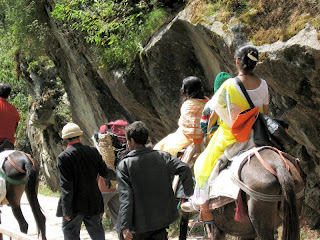 Hindu pilgrims walked or rode on ponies, dandi's, or bandi's. Kedarnath is one of four holy temple sites in the region, and is related to the story of Shiva and his transformation into a bull. Various body parts went to different regions. His lingam to Varanasi. His rump in Kedarnath. Etc. Kedarnath is also one of the water sources of the Ganga. Visiting these sites is supposed to remove one's karma/sins and allow one to die in relative peace removed from the cycle of reincarnations.
The route was hard enough. It's 14 km (8.7 miles) and a 1601 m (5252 ft) rise from 1982 m (6503 ft) in GauriKund to 3583 m (11,755 ft) at Kedarnath. Most pilgrims do the trip in one day up, and one day back. Many are not in any kind of condition for such a climb. Yet instead of being sensible and taking an overnight break at Rambara, which would be easier for their legs and lungs (acclimatization), they push themselves very hard. It seemed the same for Babadham, the 105 km barefoot pilgrimage I did in Bihar/Jarkhund in the summer. So here, all ages and shaped pushed upward at a hellish rate to reach heaven! The aged, infirm, and "lazy" hired ponies to ride, or bandi's... a large basket that a porter carried suspended from his head, or dandi's... chairs on rungs carried on the shoulders of four porters.
Most of the pilgrims looked miserable. It appeared like a penance. Being out of shape and walking at such a rate would be miserable. I concluded that riding on a pony, or other conveyance would likely be worse. One poor lady got off a pony and walked bowlegged in pain over to a bench. And as the weather cooled with higher elevations, I thought the riders must be even more miserable. Meanwhile I sang, enjoyed the view, and took my time. I was comfortable in a single layer and barefoot... the exercise generating plenty of body heat. I was in no hurry and enjoying the views. I put my sandals back on when my feet began to get sore. I thought it odd that no one else thought to make the trek a fun and enjoyable journey. But then I wasn't out to focus on my sins!
I was having the time of my life, traipsing along one careful barefoot step at a time. Feeling the energy of the Earth.. the natural church. Soon, as is often the case in India, my solitary pleasures were disrupted by a young man from Haridwar. Shod, he was walking faster. I let myself be drawn into his company. His goal was to be a champion body builder in five years. I dismayed at the thought... he was beautiful as he was, I thought. His English was only slightly better than my Hindi, and I misunderstood that he planned to stay in Rambara where I wished to stay. After meandering a hour past Rambara... I kept thinking we would reach the guesthouse where he planned to stay with his family... I found out that he planned to go all the way to Kedarnath. So I left him and retreated to Rambara where there was a delightful dormitory of clean white sheeted beds next to the river.
I was the only guest and looking forward to some quiet time and reading. I was just settling into bed when someone barged in the room looking for the manager. A family of four was caught in the rain... soaked and cold. The manager and staff were no where to be found... later it turns out they were off watching a cricket match on TV. I told the family what I knew of the rates and suggested they just move into the dorm. They did. I feel asleep to be awakened by the son who wanted to know if I knew how to give injections. No, I groggily replied. I looked over to see the middle aged man sitting up in bed on oxygen. His daughter intently sitting with him. I went to the bathroom and peed, and groggily returned to my bed. Finally, I inquired what was going on? I suggested if it was merely altitude sickness, that a simple retreat down the mountain would cure it. The daughter said that her father was suffering from kidney disease and his lungs were full of congestion. They had apparently anticipated such things and had some vein-injectable medicine for him. But no expertise in needling. I offered Reiki and went and gave the man some Reiki which he said was helping. Then someone walked in with a "doctor".. a young man who smelled of alcohol. He did seem to be knowledgeable about injections and medicine though. Unfortunately, the sick man had "no veins". After an hour and a half of unsuccessfully jabbing the man with a needle, the doctor gave up. I held my headlamp over them the whole time, and the son tried to help find the veins. I nearly grabbed the syringe and tried my intuitive luck, frustrated at the doctor's attempts. I was rather glad though that I didn't try my first injection on this difficult case. He had been imploring me to try before the doctor showed up.
I did some more Reiki on the man after the Doctor left and gave him the large Bethlehem Grid Crystal I was carrying to hold and sleep with... he seemed to be enjoying it. I asked if the family would retreat in the morning. No, they said... they would perservere and take a helicopter from the top! Crazy, I thought! Enough faith to get killed, but no enough to get cured! As I went to sleep, I had the intuitive thought that the man was dying of dehydration. In the morning I suggested water only to be told that that is the worst thing for a kidney patient! Here is someone whose kidneys are clogged and need to be flushed out. Meanwhile he is likely on heavy medications that are clogging and killing the kidneys. And so he is told not to drink water. Instead, drinks a few thimblefuls of tea or coffee... which likely only contribute to the problem. And certainly contribute to dehydration. A death sentence, I thought to myself. Then I prayed that I was wrong and that somehow he would survive in good health! No need for my judgements to affect him in the quantum consciousness of reality. I gave him the crystal after breaking of a few small pieces for offerings in my journeys.
 In the morning I chanted by the river, then set off for Kedarnath. After the sun and my walking warmed me up a bit, I slipped off my sandals to savour the trek. I thought I'd waited long enough so the pavement would be dry from the previous night's rain... and I thought I'd gotten past the places where goat herds had soiled the pavement. I rounded a corner of the switchbacked trail to find the stone path speckled in goat droppings. I laughed at my attempt for cleanliness, and pressed on. I thought of my Grandma Emma and her tales of walking barefoot through the barnyard and enjoying it! I embraced my heritage! A bit reluctantly, but I embraced it!
I hummed, chanted, and sang enjoying the scenery. I passed, and was passed by the family with the kidney patient. I hailed "Jai Kedar!" to them with a broad smile each time I passed one of them. That is the chant of this pilgrimage to cheer your sister/brother pilgrims on. The whole family was riding in dandi's.
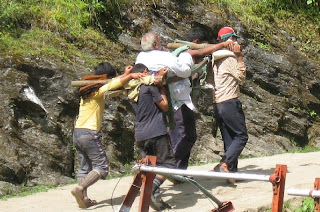 Soon, my enjoyable solitude was intruded upon by a Nepali man. He kept demanding to help carry my backpack, to which I refused. In part, I didn't want to feel colonial; in part, I was quite happy carrying it and strengthening myself; and in part, I wondered if it wasn't a ploy for money. I was soon missing my solitude and singing to myself. I wondered how I might nicely part from him. Luckily a group of porters carrying a dandi passed and said something to him... it seemed that maybe he had some work to do and he ran off! I rejoiced in my solitude again.
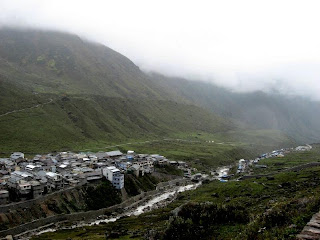
Eventually I reached the bowl of land holding Kedarnath, surrounded by mountains on three sides... like an open flower. I could see some peaks in spite of the clouds. The path was flat now, and ponies and pilgrims trudged into the center. On the outskirts of the small town surrounding the temple, I passed a row of dhabas serving food. Fresh mustard greens caught my eye and I ordered a thali... a plate of rice with dahl (lentils) and sabji (vegetables... in this case cooked mustard greens)... and I enjoyed one of my favorite greens!
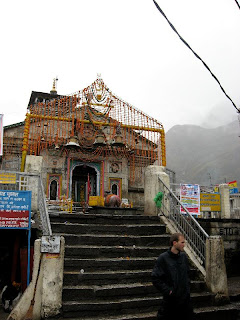 Then I proceeded into to town only to be overwhelmed by the chaos of a tourist center surrounding the temple. At 3583 m, no one lives here year round, except maybe a couple of priests. The town is merely for the tourists. Numerous priests hawked the route to sell puja's (rituals). Several tried to latch on to me as I walked through the town. I shed them. But at the temple I grew fearful. Could I just go in? Was it required to have a priest and puja? I sat and meditated on a stone wall. A doctor from the nearby clinic chatted me up. He turned out to be genuine and nice. He said I didn't need a priest... that I could just go in the temple.
The chaotic civilization scattered my mind. Maybe the altitude too. It took me a while to figure out what nearby sites I wanted to visit. Then I got "lost" for a bit from directions in pigeon English. After a failed attempt at the shortcut path to Ghandi Tal, the glacial lake where Gandhi's ashes were spread, I finally got on the right route. Unfortunately, I was quoted a time of two hours, and I wanted to return to Rambara. The day was running short. But I decided to try to make it to Ghandhi Tal.
 I clipped along up the rough path, higher above the already high Kedarnath. I practically ran. Rain started falling. I began to get wet and stopped to change from lungi to windpants and rainjacket. I debated turning back. But a group of young Indian men trudged past. So I decided to follow them. A couple of them were good at eeking out the shortcuts between the switchbacks. I was glad I perservered because in a few minutes we reached the lake. It lay about 30 feet below the path in a cloud bank. Moss green shown through from the rocks below the clear water. It was beautiful. I didn't dare photograph it in the thick rain/sleet for fear of my camera getting too wet. I made some prayers and tossed a piece of Bethlehem grid crystal into the beautiful abyss.
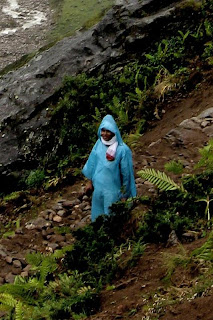 I barely finished my prayers and chants when a plastic covered figure came out of the mist. A monk from Bangledesh who had trekked over the glaciers from Gangotri greeted me. I glanced down to the ground and picked up a small stone that "spoke" to me, putting it my pocket. I continued with my "work" to visit a cairn that lay above me on glacial til. Not much to see there, I returned to find the monk waiting for me. I wondered where his guide and/or companions were. I learned he wanted to join me in the descent. I was a bit dismayed as I was happy alone, and was now bent on running down the mountain so I could get on to my other trekking destinations.
We made our way down to Kedarnath, where I visited the Temple and he continued downwards. The temple was anticlimatic. I managed to get through it with out buying a puja (ceremony) from the many priests. I then started jogging down the mountain. I was drenched. I was cold. I didn't fancy the clustered village of Kedarnath. And I was ready to head out to Hemkund the next day. Even in my jogging, I was passed by Nepali porters carrying the dandi's (chairs with passengers). I marveled at their synchronized steps and endurance. They jogged down the road with their loads. They seemed to dodge the raindrops while their passengers grew wet and cold. I marveled at their seeming comfort in simple cotton clothes that seemed to shed rain while I grew colder and wetter under my poly base layer and raincoat.
Just above Rambara I ran into my glacier trekking monk friend. I wasn't sure I wanted to end my solitude. We trod down into Rambara together. The rain kept us wet and cold while the lower elevation took a bit of the edge off the chill. In my mind, I mulled over the idea of staying in Rambara, but decided I wanted to head to Garikund so I could leave for Hemkund the next day. About 100 m past the guesthouse I'd stayed at in Rambara, I felt a twinge of pain in my left knee. Stupidly, I thought it silly to return up hill. Surely I'd cruise on down to Garikund in no time. Aches continued to spread through both legs with each of the 8 km. The monk tried to talk with me but my misery kept me removed. He shared some glucose powder with me, which I mixed with water. I began to realize I hadn't taken the best care of myself. Water and food I knew would go along way to rejuvenating me. I tried to drink more water. I felt a lack of time, in wanting to get to Garikund by dark.
We trudged onwards down the cobbled trail, stepping aside as ponies with cold wet riders clipped past us, sometimes nearly running us down. The monk went into a spontaneous spiel on the wonders of meditation and how if you meditate into pain it will go away. My ego made me feel talked down to... I knew all that from a Reiki perspective and wasn't sure I needed the free advertisement! Nonetheless, I tried to heed the advice... I don't think he realized how much pain I was in. I tried to meditate the pain away. Well, as well as one can when they are trekking down a mountain in cold wet rain. About as hard and fun as trying to do a sitting meditation in a room of mosquitoes! A few minutes later I grumbled to the monk that I was trying and the meditation thing wasn't working! He acknowledged the difficulty that we all face. He acknowledged his own challenges.
We trudged on through the rain and mud. I stepped off to pee a few times to let out all the water I was drinking in hopes of lubricating my knees. At one point, he asked if I wanted to stay with him in the ashram; he'd have to check with the manager of course. I never gave him a direct answer. The truth was I wasn't sure if it would be nurturing. Perhaps it would be better for me to take care of myself. Finally, he asked if I was going to answer his offer. I said I wanted to see how things went. He didn't know where the ashram was. I didn't want to walk any further than I had to.
About an hour after dark we finally reached Garikund. A hotelier asked me if I wanted a room as I went by... how much I asked? 100rs he replied. I was going to check it out, but the monk was upset that I wasn't going on to the ashram. He said it was near. I hobbled along like a spent race horse. The pain was unbearable as it had been for nearly 2 hours. We reached the ashram which was down by the hot spring. The manager did not permit me to stay. He told me to follow a boy, who led me to the hotel next door. The hotel didn't thrill me a bit. The manager led me all the way up the stairs to the fourth floor. I gimped up the stairs. He showed me the room. Grimy green walls and musty odor didn't impress me. He said it was 250rs. I told him I'd seen another for 100rs. He was shocked when I started following him back out. "Don't you want the room?" I said why should I pay 250rs for a room when I can get one for 100rs! He finally relented to 150rs. My legs were aching so much, I took it, top floor and all.
I gimped down to the hot springs 50 m around the corner, and found the "pool" emptied for cleaning. Uggh. I returned to my room for a cold bucket shower. I went for food. I risked ordering palak paneer (spinach cheese curry) from a priceless menu, thinking I'd treat myself to a favorite dish. It wasn't so good. Then I was charged 90rs which seemed outrageous. My feet hurt from rubbing on my sandal straps. My legs ached. I lay in bed. I went to a pharmacist for Tiger Balm. All he had was some chemical heating lotion. Not even anything like Ben Gay. I got some Vitamins C and B. He said I'd be fine after a day of rest. I wasn't so sure.
Miserable. I lay in bed. I yearned for home. "I want to go home!", I moaned to myself. A typical response to sickness in a foreign land. I tried to imagine home Images of the US flashed through my mind... my last domicile in San Francisco, my parents house, my Aunt and Uncle's house. But I couldn't really imagine going back and creating a home, setting up housekeeping, etc. And later sitting in the steaming waters of the public bath, a stone adorned tank similar to a swimming pool, I began to appreciate where I was. In India. In a public hot pool. Surrounded by men (women have a separate pool). It was comforting. And I began to see my confusion.
I want to go home. But where is my home? Fond images from all over the world popped into my head. Steamy saunas of Thailand, and the familiar streets of Chiang Mai and Bangkok with their marvelous street food. The foggy hills of San Francisco and my faerie friends there. The stone lined streets of Thamel, Kathmandu, Nepal, and the little disco that calls itself the Funky Buddha Bar. The hills of the Butternut Valley where my father grew up in upstate New York. The Clay Hotel Hostel and Washington Street in South Beach, Miami. The glowing energy of Joshua Tree in California. And my beloved Mauna Loa in Hawaii. The friendly people of Laos and tubing in Vang Viang.
I realized I have no place to call home anymore. My sense of place is shattered. I'm truly homeless. I've virtually shattered my identity. The only thing left to do is to be at home wherever I am. The only thing left to do is to be present with who I am in the moment.
I felt empty. I felt pain. I lay in my bed depressed. The pain and injury didn't fit into my plans. The balm from the pharmacist didn't seem to work. I was miserable. In 36 hours I'd gone from discovered my greatest joy... traipsing up the mountain... to loosing it. To top things off, I felt a cold coming on.
Then I picked up the stone I'd found by Ghandi Tal (the lake above Kedarnath). I felt the vibration and energy of the stone permeate my body. I grew excited. The "other" reality. The Reality of Reiki and metaphysics and energy healing was back! I thought to myself how years ago after getting into Reiki I had learned to disown the reality of having/catching colds. I had started viewing them as detox symptoms from my body clearing toxins. Why, that made sense now after my first big exercise in a month. Further I remembered how several years ago I had decided to quit having colds, and merely seen them as patterns of being that I could choose my way out of if I started to have symptoms. Then I realized my knees and legs were no different! Why was I projecting a self hypnotic future of not being able to continue on my treks? I started to remember my own magic. The power of empowerment I had shared with so many clients in my Reiki practice. I remembered how several years ago I would simply ask my body to release the pattern if I started to feel twinges of knee pain. And it would work. I remembered how one day riding my bike up a hill to work, I had felt a twinge of knee pain, and banished it off, saying "I don't have time for this now!"
I grew excited. I started setting intentions for healing for alignment. I started to envision myself going trekking at Hemkund. The next few days rained. I spent two days in that hotel room. I discovered the best sleep in months as the raging river made a beautiful melody that drifted in the bathroom window. I enjoyed dreamy sleeps that felt like streams of consciousness. Memories from my past bubbled through my minds eye as the rains bubbled through the hills. I felt the most relaxed I had in months. I felt good! I slept and napped and Reiki'd myself throughout the day. I found a dhaba that had the best all you can eat thali (only 35rs) ever! I ate there twice a day. The staff treated me like a king. In between I soaked in the hot sulphur waters of the public bath, enjoying the views of the other men. My pains indeed went away. And finally one evening I booked a ticket for the 6 am bus to Govindghat, the departure point for the Hemkund trek.
The magical monk from Bangladesh, who had popped out of the fogs at Ghandi Tal, I never saw again. I tried to find him the day after our descent, but he had left. I'll always wonder how he transversed the glaciers from Gangotri to Kedarnath, apparently alone in a lungi and a plastic raincoat. Like so many others we meet walking about the world, he flashed out of my life as quickly as he appeared.
The bus stopped about 6 pm in a small town in the mountains. I didn't know where I was. I thought we were just taking a dinner break as I didn't expect to reach my destination until 8pm. Finally the conductor managed to convey to me that the bus was going no farther! And I would have to catch another bus in the morning. I tried several places to get a room, but all were booked. As I looked for a room, I learned that I was in RudraPrayag, which was my destination... we had arrived two hours early because the roads were "good"! You could have fooled me! Bumpy, full of traffic, and blocked by landslides, the roads didn't seem good to me! I would later find out on other bus trips in the near mountains, that we were lucky. Sometimes landslides caused delays of several hours or more!
Surprisingly, in the congested transport hub town, in the guesthouse I finally found a room in, I got a good nights sleep in spite of the noise. I found a 7am bus to Garikund (1982 m/6503 ft), the starting point for the trek to Kedarnath. Arrived four hours later, on schedule. I took a bath in the public hot springs... like small swimming pool in the center of town, fed by natural, hot, sulphur water. Then I started my trek. It felt very good. Amazingly good. I remembered how much I love the mountains, and I realized it had been a long time since I'd been any place near quiet. I'd been in the sweltering, noisy plains of India for several months. It was only a 8 km (5 mile) hike to Rambara (2591 m/8501 ft), half way up the mountain, where I planned to spend the night. I was walking too fast. I didn't want to pass the scenery so fast, plus I wanted to go easy on my body which hadn't hiked for a while, and also go slowly on the elevation gain for acclimitization purposes. So I took off my sandals and went barefoot on the nice smooth stone path. I savoured the scenery.

I practiced the "Christ walk" an old hippie had told me about in California. He said he'd met a guy in the Summer of Love whose "trip" was the "Christ walk"... it meant to walk barefoot, putting the toes down first, before letting the heal come down. Walking this way is easier on your joints, and allows you to sample a footstep before committing to it... useful in case of harsh ground. And the idea was that it gets you in touch with the Earth.. the Goddess... in some spiritualities. So I practised my Christ walk and remembered a chant from Rainbow Gatherings "Mother I feel you under my feet... Mother I feel your heart beat... Heya heya heya, ya haya haya ho, haya haya haya ha-ya ho!"... and no, this doesn't mean stepping on your biological Mother! It's about the Earth Mother! It felt good and got me in touch with the Reiki/earth energies. It slowed me down. It allowed me to enjoy each step and look around. I felt myself flow into a meditative bliss. I beamed and glowed.
"First be natural. Then you will be flowing in the river of the natural. And one day the river will fall into the ocean of the supernatural." -- Osho
 Hindu pilgrims walked or rode on ponies, dandi's, or bandi's. Kedarnath is one of four holy temple sites in the region, and is related to the story of Shiva and his transformation into a bull. Various body parts went to different regions. His lingam to Varanasi. His rump in Kedarnath. Etc. Kedarnath is also one of the water sources of the Ganga. Visiting these sites is supposed to remove one's karma/sins and allow one to die in relative peace removed from the cycle of reincarnations.
The route was hard enough. It's 14 km (8.7 miles) and a 1601 m (5252 ft) rise from 1982 m (6503 ft) in GauriKund to 3583 m (11,755 ft) at Kedarnath. Most pilgrims do the trip in one day up, and one day back. Many are not in any kind of condition for such a climb. Yet instead of being sensible and taking an overnight break at Rambara, which would be easier for their legs and lungs (acclimatization), they push themselves very hard. It seemed the same for Babadham, the 105 km barefoot pilgrimage I did in Bihar/Jarkhund in the summer. So here, all ages and shaped pushed upward at a hellish rate to reach heaven! The aged, infirm, and "lazy" hired ponies to ride, or bandi's... a large basket that a porter carried suspended from his head, or dandi's... chairs on rungs carried on the shoulders of four porters.
Most of the pilgrims looked miserable. It appeared like a penance. Being out of shape and walking at such a rate would be miserable. I concluded that riding on a pony, or other conveyance would likely be worse. One poor lady got off a pony and walked bowlegged in pain over to a bench. And as the weather cooled with higher elevations, I thought the riders must be even more miserable. Meanwhile I sang, enjoyed the view, and took my time. I was comfortable in a single layer and barefoot... the exercise generating plenty of body heat. I was in no hurry and enjoying the views. I put my sandals back on when my feet began to get sore. I thought it odd that no one else thought to make the trek a fun and enjoyable journey. But then I wasn't out to focus on my sins!
I was having the time of my life, traipsing along one careful barefoot step at a time. Feeling the energy of the Earth.. the natural church. Soon, as is often the case in India, my solitary pleasures were disrupted by a young man from Haridwar. Shod, he was walking faster. I let myself be drawn into his company. His goal was to be a champion body builder in five years. I dismayed at the thought... he was beautiful as he was, I thought. His English was only slightly better than my Hindi, and I misunderstood that he planned to stay in Rambara where I wished to stay. After meandering a hour past Rambara... I kept thinking we would reach the guesthouse where he planned to stay with his family... I found out that he planned to go all the way to Kedarnath. So I left him and retreated to Rambara where there was a delightful dormitory of clean white sheeted beds next to the river.
I was the only guest and looking forward to some quiet time and reading. I was just settling into bed when someone barged in the room looking for the manager. A family of four was caught in the rain... soaked and cold. The manager and staff were no where to be found... later it turns out they were off watching a cricket match on TV. I told the family what I knew of the rates and suggested they just move into the dorm. They did. I feel asleep to be awakened by the son who wanted to know if I knew how to give injections. No, I groggily replied. I looked over to see the middle aged man sitting up in bed on oxygen. His daughter intently sitting with him. I went to the bathroom and peed, and groggily returned to my bed. Finally, I inquired what was going on? I suggested if it was merely altitude sickness, that a simple retreat down the mountain would cure it. The daughter said that her father was suffering from kidney disease and his lungs were full of congestion. They had apparently anticipated such things and had some vein-injectable medicine for him. But no expertise in needling. I offered Reiki and went and gave the man some Reiki which he said was helping. Then someone walked in with a "doctor".. a young man who smelled of alcohol. He did seem to be knowledgeable about injections and medicine though. Unfortunately, the sick man had "no veins". After an hour and a half of unsuccessfully jabbing the man with a needle, the doctor gave up. I held my headlamp over them the whole time, and the son tried to help find the veins. I nearly grabbed the syringe and tried my intuitive luck, frustrated at the doctor's attempts. I was rather glad though that I didn't try my first injection on this difficult case. He had been imploring me to try before the doctor showed up.
I did some more Reiki on the man after the Doctor left and gave him the large Bethlehem Grid Crystal I was carrying to hold and sleep with... he seemed to be enjoying it. I asked if the family would retreat in the morning. No, they said... they would perservere and take a helicopter from the top! Crazy, I thought! Enough faith to get killed, but no enough to get cured! As I went to sleep, I had the intuitive thought that the man was dying of dehydration. In the morning I suggested water only to be told that that is the worst thing for a kidney patient! Here is someone whose kidneys are clogged and need to be flushed out. Meanwhile he is likely on heavy medications that are clogging and killing the kidneys. And so he is told not to drink water. Instead, drinks a few thimblefuls of tea or coffee... which likely only contribute to the problem. And certainly contribute to dehydration. A death sentence, I thought to myself. Then I prayed that I was wrong and that somehow he would survive in good health! No need for my judgements to affect him in the quantum consciousness of reality. I gave him the crystal after breaking of a few small pieces for offerings in my journeys.
 In the morning I chanted by the river, then set off for Kedarnath. After the sun and my walking warmed me up a bit, I slipped off my sandals to savour the trek. I thought I'd waited long enough so the pavement would be dry from the previous night's rain... and I thought I'd gotten past the places where goat herds had soiled the pavement. I rounded a corner of the switchbacked trail to find the stone path speckled in goat droppings. I laughed at my attempt for cleanliness, and pressed on. I thought of my Grandma Emma and her tales of walking barefoot through the barnyard and enjoying it! I embraced my heritage! A bit reluctantly, but I embraced it!
I hummed, chanted, and sang enjoying the scenery. I passed, and was passed by the family with the kidney patient. I hailed "Jai Kedar!" to them with a broad smile each time I passed one of them. That is the chant of this pilgrimage to cheer your sister/brother pilgrims on. The whole family was riding in dandi's.
 Soon, my enjoyable solitude was intruded upon by a Nepali man. He kept demanding to help carry my backpack, to which I refused. In part, I didn't want to feel colonial; in part, I was quite happy carrying it and strengthening myself; and in part, I wondered if it wasn't a ploy for money. I was soon missing my solitude and singing to myself. I wondered how I might nicely part from him. Luckily a group of porters carrying a dandi passed and said something to him... it seemed that maybe he had some work to do and he ran off! I rejoiced in my solitude again.
 Eventually I reached the bowl of land holding Kedarnath, surrounded by mountains on three sides... like an open flower. I could see some peaks in spite of the clouds. The path was flat now, and ponies and pilgrims trudged into the center. On the outskirts of the small town surrounding the temple, I passed a row of dhabas serving food. Fresh mustard greens caught my eye and I ordered a thali... a plate of rice with dahl (lentils) and sabji (vegetables... in this case cooked mustard greens)... and I enjoyed one of my favorite greens!
 Then I proceeded into to town only to be overwhelmed by the chaos of a tourist center surrounding the temple. At 3583 m, no one lives here year round, except maybe a couple of priests. The town is merely for the tourists. Numerous priests hawked the route to sell puja's (rituals). Several tried to latch on to me as I walked through the town. I shed them. But at the temple I grew fearful. Could I just go in? Was it required to have a priest and puja? I sat and meditated on a stone wall. A doctor from the nearby clinic chatted me up. He turned out to be genuine and nice. He said I didn't need a priest... that I could just go in the temple.
 The chaotic civilization scattered my mind. Maybe the altitude too. It took me a while to figure out what nearby sites I wanted to visit. Then I got "lost" for a bit from directions in pigeon English. After a failed attempt at the shortcut path to Ghandi Tal, the glacial lake where Gandhi's ashes were spread, I finally got on the right route. Unfortunately, I was quoted a time of two hours, and I wanted to return to Rambara. The day was running short. But I decided to try to make it to Ghandhi Tal.
 I clipped along up the rough path, higher above the already high Kedarnath. I practically ran. Rain started falling. I began to get wet and stopped to change from lungi to windpants and rainjacket. I debated turning back. But a group of young Indian men trudged past. So I decided to follow them. A couple of them were good at eeking out the shortcuts between the switchbacks. I was glad I perservered because in a few minutes we reached the lake. It lay about 30 feet below the path in a cloud bank. Moss green shown through from the rocks below the clear water. It was beautiful. I didn't dare photograph it in the thick rain/sleet for fear of my camera getting too wet. I made some prayers and tossed a piece of Bethlehem grid crystal into the beautiful abyss.
  I barely finished my prayers and chants when a plastic covered figure came out of the mist. A monk from Bangledesh who had trekked over the glaciers from Gangotri greeted me. I glanced down to the ground and picked up a small stone that "spoke" to me, putting it my pocket. I continued with my "work" to visit a cairn that lay above me on glacial til. Not much to see there, I returned to find the monk waiting for me. I wondered where his guide and/or companions were. I learned he wanted to join me in the descent. I was a bit dismayed as I was happy alone, and was now bent on running down the mountain so I could get on to my other trekking destinations.
 We made our way down to Kedarnath, where I visited the Temple and he continued downwards. The temple was anticlimatic. I managed to get through it with out buying a puja (ceremony) from the many priests. I then started jogging down the mountain. I was drenched. I was cold. I didn't fancy the clustered village of Kedarnath. And I was ready to head out to Hemkund the next day. Even in my jogging, I was passed by Nepali porters carrying the dandi's (chairs with passengers). I marveled at their synchronized steps and endurance. They jogged down the road with their loads. They seemed to dodge the raindrops while their passengers grew wet and cold. I marveled at their seeming comfort in simple cotton clothes that seemed to shed rain while I grew colder and wetter under my poly base layer and raincoat.
Just above Rambara I ran into my glacier trekking monk friend. I wasn't sure I wanted to end my solitude. We trod down into Rambara together. The rain kept us wet and cold while the lower elevation took a bit of the edge off the chill. In my mind, I mulled over the idea of staying in Rambara, but decided I wanted to head to Garikund so I could leave for Hemkund the next day. About 100 m past the guesthouse I'd stayed at in Rambara, I felt a twinge of pain in my left knee. Stupidly, I thought it silly to return up hill. Surely I'd cruise on down to Garikund in no time. Aches continued to spread through both legs with each of the 8 km. The monk tried to talk with me but my misery kept me removed. He shared some glucose powder with me, which I mixed with water. I began to realize I hadn't taken the best care of myself. Water and food I knew would go along way to rejuvenating me. I tried to drink more water. I felt a lack of time, in wanting to get to Garikund by dark.
We trudged onwards down the cobbled trail, stepping aside as ponies with cold wet riders clipped past us, sometimes nearly running us down. The monk went into a spontaneous spiel on the wonders of meditation and how if you meditate into pain it will go away. My ego made me feel talked down to... I knew all that from a Reiki perspective and wasn't sure I needed the free advertisement! Nonetheless, I tried to heed the advice... I don't think he realized how much pain I was in. I tried to meditate the pain away. Well, as well as one can when they are trekking down a mountain in cold wet rain. About as hard and fun as trying to do a sitting meditation in a room of mosquitoes! A few minutes later I grumbled to the monk that I was trying and the meditation thing wasn't working! He acknowledged the difficulty that we all face. He acknowledged his own challenges.
We trudged on through the rain and mud. I stepped off to pee a few times to let out all the water I was drinking in hopes of lubricating my knees. At one point, he asked if I wanted to stay with him in the ashram; he'd have to check with the manager of course. I never gave him a direct answer. The truth was I wasn't sure if it would be nurturing. Perhaps it would be better for me to take care of myself. Finally, he asked if I was going to answer his offer. I said I wanted to see how things went. He didn't know where the ashram was. I didn't want to walk any further than I had to.
About an hour after dark we finally reached Garikund. A hotelier asked me if I wanted a room as I went by... how much I asked? 100rs he replied. I was going to check it out, but the monk was upset that I wasn't going on to the ashram. He said it was near. I hobbled along like a spent race horse. The pain was unbearable as it had been for nearly 2 hours. We reached the ashram which was down by the hot spring. The manager did not permit me to stay. He told me to follow a boy, who led me to the hotel next door. The hotel didn't thrill me a bit. The manager led me all the way up the stairs to the fourth floor. I gimped up the stairs. He showed me the room. Grimy green walls and musty odor didn't impress me. He said it was 250rs. I told him I'd seen another for 100rs. He was shocked when I started following him back out. "Don't you want the room?" I said why should I pay 250rs for a room when I can get one for 100rs! He finally relented to 150rs. My legs were aching so much, I took it, top floor and all.
I gimped down to the hot springs 50 m around the corner, and found the "pool" emptied for cleaning. Uggh. I returned to my room for a cold bucket shower. I went for food. I risked ordering palak paneer (spinach cheese curry) from a priceless menu, thinking I'd treat myself to a favorite dish. It wasn't so good. Then I was charged 90rs which seemed outrageous. My feet hurt from rubbing on my sandal straps. My legs ached. I lay in bed. I went to a pharmacist for Tiger Balm. All he had was some chemical heating lotion. Not even anything like Ben Gay. I got some Vitamins C and B. He said I'd be fine after a day of rest. I wasn't so sure.
Miserable. I lay in bed. I yearned for home. "I want to go home!", I moaned to myself. A typical response to sickness in a foreign land. I tried to imagine home Images of the US flashed through my mind... my last domicile in San Francisco, my parents house, my Aunt and Uncle's house. But I couldn't really imagine going back and creating a home, setting up housekeeping, etc. And later sitting in the steaming waters of the public bath, a stone adorned tank similar to a swimming pool, I began to appreciate where I was. In India. In a public hot pool. Surrounded by men (women have a separate pool). It was comforting. And I began to see my confusion.
I want to go home. But where is my home? Fond images from all over the world popped into my head. Steamy saunas of Thailand, and the familiar streets of Chiang Mai and Bangkok with their marvelous street food. The foggy hills of San Francisco and my faerie friends there. The stone lined streets of Thamel, Kathmandu, Nepal, and the little disco that calls itself the Funky Buddha Bar. The hills of the Butternut Valley where my father grew up in upstate New York. The Clay Hotel Hostel and Washington Street in South Beach, Miami. The glowing energy of Joshua Tree in California. And my beloved Mauna Loa in Hawaii. The friendly people of Laos and tubing in Vang Viang.
I realized I have no place to call home anymore. My sense of place is shattered. I'm truly homeless. I've virtually shattered my identity. The only thing left to do is to be at home wherever I am. The only thing left to do is to be present with who I am in the moment.
I felt empty. I felt pain. I lay in my bed depressed. The pain and injury didn't fit into my plans. The balm from the pharmacist didn't seem to work. I was miserable. In 36 hours I'd gone from discovered my greatest joy... traipsing up the mountain... to loosing it. To top things off, I felt a cold coming on.
Then I picked up the stone I'd found by Ghandi Tal (the lake above Kedarnath). I felt the vibration and energy of the stone permeate my body. I grew excited. The "other" reality. The Reality of Reiki and metaphysics and energy healing was back! I thought to myself how years ago after getting into Reiki I had learned to disown the reality of having/catching colds. I had started viewing them as detox symptoms from my body clearing toxins. Why, that made sense now after my first big exercise in a month. Further I remembered how several years ago I had decided to quit having colds, and merely seen them as patterns of being that I could choose my way out of if I started to have symptoms. Then I realized my knees and legs were no different! Why was I projecting a self hypnotic future of not being able to continue on my treks? I started to remember my own magic. The power of empowerment I had shared with so many clients in my Reiki practice. I remembered how several years ago I would simply ask my body to release the pattern if I started to feel twinges of knee pain. And it would work. I remembered how one day riding my bike up a hill to work, I had felt a twinge of knee pain, and banished it off, saying "I don't have time for this now!"
I grew excited. I started setting intentions for healing for alignment. I started to envision myself going trekking at Hemkund. The next few days rained. I spent two days in that hotel room. I discovered the best sleep in months as the raging river made a beautiful melody that drifted in the bathroom window. I enjoyed dreamy sleeps that felt like streams of consciousness. Memories from my past bubbled through my minds eye as the rains bubbled through the hills. I felt the most relaxed I had in months. I felt good! I slept and napped and Reiki'd myself throughout the day. I found a dhaba that had the best all you can eat thali (only 35rs) ever! I ate there twice a day. The staff treated me like a king. In between I soaked in the hot sulphur waters of the public bath, enjoying the views of the other men. My pains indeed went away. And finally one evening I booked a ticket for the 6 am bus to Govindghat, the departure point for the Hemkund trek.
The magical monk from Bangladesh, who had popped out of the fogs at Ghandi Tal, I never saw again. I tried to find him the day after our descent, but he had left. I'll always wonder how he transversed the glaciers from Gangotri to Kedarnath, apparently alone in a lungi and a plastic raincoat. Like so many others we meet walking about the world, he flashed out of my life as quickly as he appeared.
Saturday, September 01, 2007
The Trouble with Tourists
I read William Sutcliffe's "Are You Experienced?" one night in a delightful reading frenzy. It's a bit racy at times, but captures some of the tourist and traveller vibe on the road in India. And has some hilarious black humor.
The day after I read it I sat down in a crowded restuarant in Bodhgaya opposite two German fellows on their third day in India. I was shocked that they had arrived in Bodhgaya after 3 days, since they had landed in Mumbai (Bombay). They had managed to visit Varanasi in between. No small feat. It turns out they had flown from Mumbai to Varanasi. They were in shellshock. No doubt. Varanasi is an intense town. It's the epitomy of India. Filthy. Crazy to the western mind (I met an Irish guy there two years ago, who said "cows are supposed to be in pastures, not in town!"). The German fellows said they were overcome by the smells and filth. Every shop has a different smell... intense inscense, strong foods, burning charcoal, burning garbage. The street has a variety of dung in it... most often smelling a bit like a cow barn.
They had been hassled by touts. Sold a bus ticket for a bus that didn't exist. When they got to where the bus was supposed to be there was nothing. They were at the mercy of a rickshaw driver who suggested they go to Bodhgaya. Not knowing what else to do, they agreed to pay him an inflated price to go to the train station. They were smart enough to say they wouldn't pay him if he was lying about the train.
They said "everyone here is lying and cheating!" They had taken a proper taxi from Gaya to Bodhgaya. Everyone takes rickshaws. They had clutched there bags beneath their feet afraid of being ripped off. They were truly in shock and fear. I don't know if they didn't have a guide book or what. Usually I try to get some information on transport and prices.
They had a crazy 5 week itinerary. Mumbai, Varanasi, Bodhgaya, Patna, Gaya, Kolkata, Varanasi, Mumbai, Goa, and the west coast. I tried to tell them there were two ways I knew of to get some relief from the intensity of India... one is to go to non-tourist areas. Sometimes just a few kilometers will make all the difference in being suffocated by touts and aggressive approaches. And then there is the mountains... the Buddhists, and the mountains are much less intense.
I tried to convince them to take a trip to Darjeeling or Sikkim. They had 18 days before their flight from Varanasi to Mumbai. Kolkata, I told them would be a repeat of Varanasi. Intense. Poverty. Filth. Touts. Nobody goes to Gaya and Patna... I had never heard of anything interesting about them... they were just intense, crime-ridden travel hubs from what I had heard.
An American guy Jason sat down. He's been doing research on NGO's in Bodhgaya and lived there 6 months aready. He tried to convince them to change their itinerary as well. He said, "You know all that filth that disgusted you in Varanasi... the dung, and urine, and dead rats, and half burned trash? when it rains in Kolkata, the streets flood up to your waist and you have to walk through it!"
I saw the German's the next day. They had been on one of the school tours to see the money making school operations. (I'm proud to say, I didn't see one school in Bodhgaya). It's the number one touted item. The German guy went on about how the children sit in a dark dingy room without light, or proper books, or paper etc. He said how amazing it was because you hear such things about the third world, and now he has seen it with his own eyes. I didn't have the heart to tell him it was likely not so real as he thought.. but merely a staged show to let tourists feel compassionate and charitable. I felt sad because I'm sure that such ill equipped schools do exist... in a way the one he saw existed... but it was merely a cash hog for it's owners.
They had booked a train for Darjeeling. I was relieved for them.
It reminded me of a tourist I met my first days in Bodhgaya. She had been on a local tour with a local guide to see some poverty stricken village. She exclaimed, "They are so poor they eat rice and cow dung!" "I don't think so," I said, "I know they dry cow dung to burn for fuel, but I don't think they eat it." "No, really", she said, "I had a local guide and he showed me how they shape it into round disks and dry it in the sun... and he told me they are so poor that is what they eat!"
I took it in. I said, "Well, in India, anything is possible, I suppose." Yesterday, I told my local friend Kundan about it, and he burst out laughing, "Tourists will believe anything!" I joked that maybe we should make a business an make fried cow dung to sell to tourists. It could be like the fried grasshopper carts I see roaming the streets late at night in Thailand to take advantage of drunk tourists who want to show off.
I tried to explain to Kundan the humorous folk song "Moose Turd Pie." The song is about a group of cowboys and how whoever complains about the food has to cook. It goes on about how this one night, the cook makes moose turd pie and feeds it to the cowboys. One cowboy exclaims, "Uggh, this is moose turd pie.... but it's the best I've ever had!"
The day after I read it I sat down in a crowded restuarant in Bodhgaya opposite two German fellows on their third day in India. I was shocked that they had arrived in Bodhgaya after 3 days, since they had landed in Mumbai (Bombay). They had managed to visit Varanasi in between. No small feat. It turns out they had flown from Mumbai to Varanasi. They were in shellshock. No doubt. Varanasi is an intense town. It's the epitomy of India. Filthy. Crazy to the western mind (I met an Irish guy there two years ago, who said "cows are supposed to be in pastures, not in town!"). The German fellows said they were overcome by the smells and filth. Every shop has a different smell... intense inscense, strong foods, burning charcoal, burning garbage. The street has a variety of dung in it... most often smelling a bit like a cow barn.
They had been hassled by touts. Sold a bus ticket for a bus that didn't exist. When they got to where the bus was supposed to be there was nothing. They were at the mercy of a rickshaw driver who suggested they go to Bodhgaya. Not knowing what else to do, they agreed to pay him an inflated price to go to the train station. They were smart enough to say they wouldn't pay him if he was lying about the train.
They said "everyone here is lying and cheating!" They had taken a proper taxi from Gaya to Bodhgaya. Everyone takes rickshaws. They had clutched there bags beneath their feet afraid of being ripped off. They were truly in shock and fear. I don't know if they didn't have a guide book or what. Usually I try to get some information on transport and prices.
They had a crazy 5 week itinerary. Mumbai, Varanasi, Bodhgaya, Patna, Gaya, Kolkata, Varanasi, Mumbai, Goa, and the west coast. I tried to tell them there were two ways I knew of to get some relief from the intensity of India... one is to go to non-tourist areas. Sometimes just a few kilometers will make all the difference in being suffocated by touts and aggressive approaches. And then there is the mountains... the Buddhists, and the mountains are much less intense.
I tried to convince them to take a trip to Darjeeling or Sikkim. They had 18 days before their flight from Varanasi to Mumbai. Kolkata, I told them would be a repeat of Varanasi. Intense. Poverty. Filth. Touts. Nobody goes to Gaya and Patna... I had never heard of anything interesting about them... they were just intense, crime-ridden travel hubs from what I had heard.
An American guy Jason sat down. He's been doing research on NGO's in Bodhgaya and lived there 6 months aready. He tried to convince them to change their itinerary as well. He said, "You know all that filth that disgusted you in Varanasi... the dung, and urine, and dead rats, and half burned trash? when it rains in Kolkata, the streets flood up to your waist and you have to walk through it!"
I saw the German's the next day. They had been on one of the school tours to see the money making school operations. (I'm proud to say, I didn't see one school in Bodhgaya). It's the number one touted item. The German guy went on about how the children sit in a dark dingy room without light, or proper books, or paper etc. He said how amazing it was because you hear such things about the third world, and now he has seen it with his own eyes. I didn't have the heart to tell him it was likely not so real as he thought.. but merely a staged show to let tourists feel compassionate and charitable. I felt sad because I'm sure that such ill equipped schools do exist... in a way the one he saw existed... but it was merely a cash hog for it's owners.
They had booked a train for Darjeeling. I was relieved for them.
It reminded me of a tourist I met my first days in Bodhgaya. She had been on a local tour with a local guide to see some poverty stricken village. She exclaimed, "They are so poor they eat rice and cow dung!" "I don't think so," I said, "I know they dry cow dung to burn for fuel, but I don't think they eat it." "No, really", she said, "I had a local guide and he showed me how they shape it into round disks and dry it in the sun... and he told me they are so poor that is what they eat!"
I took it in. I said, "Well, in India, anything is possible, I suppose." Yesterday, I told my local friend Kundan about it, and he burst out laughing, "Tourists will believe anything!" I joked that maybe we should make a business an make fried cow dung to sell to tourists. It could be like the fried grasshopper carts I see roaming the streets late at night in Thailand to take advantage of drunk tourists who want to show off.
I tried to explain to Kundan the humorous folk song "Moose Turd Pie." The song is about a group of cowboys and how whoever complains about the food has to cook. It goes on about how this one night, the cook makes moose turd pie and feeds it to the cowboys. One cowboy exclaims, "Uggh, this is moose turd pie.... but it's the best I've ever had!"
Bye Bye Bodhgaya: Hello Varanasi
I left Bodhgaya at 4am on 31 August. My last day found me a bit sad and resisting leaving. I spent some time under the Boddhi Tree and regretted not having spent a whole day at one time sitting under it. I'm not sure I have ever felt such a powerful place... everytime I went there and sat under it, I felt an amazing energy pervade me instantly.
Over the last few days in Bodhgaya, I finally regained my strength and felt strong again after the pilgrimage. I befriended the chef at the next guesthouse and spent some time with him when I could... it was difficult because of communication and also that he was bad with appointments. Twice he said he would come by my room at a given time and never showed up. A man that had sold me a piece of plastic for the pilgrimage emailed me worried that I did not get back safely. I went to visit him at his father's hardware shop. They were so nice. They treated me to chai and asked how the pilgrimage went. Narij had given me his mobile number in case I had any trouble. We tried to meet for a bike ride, but when I showed up at his house at the appointed time, he was not there. Local custom is to give the guest tea and biscuits. Sweet, but I find it a bit grueling to have to sit through awkward social situations with those that I can't communicate with. And I hate being put on a pedestal. One day Narij took me to his house and I was given some dry snack mix... apparently only for me to eat and not the family. I went to work trying to politely down it all quickly. I left my chai(tea) alone wanting to save it to was the food down with. A woman who lived at the house told me "Drink your tea!". People here are often willing to tell you what to do. I am tired of it.
I made the mistake of agreeing to go to Sunil's (the chef) village one day. I was in a very Western frame of mind. I alotted 1.5 hours for the village trip, then I wanted to do some internet, and try to visit some other folks that had helped me prepare for the pilgrimage. The twenty minutes of predeparture time turned into an hour. It didn't help that I had a bout of diarrhea. The 5-10 minutes I was quoted for the travel time turned into 30 minutes. Sunil asked if I had gifts for his family while we were on the way. Why he didn't think to brief me before I don't know. I was also upset because I hate being treated like some ATM or gift machine. I told him I didn't have gifts. I thought we could just skip it. Next thing I know we stop at a shop/stall and he asks for 22 rupees (a small amount) and purchases a bunch of candies and some sweets (kind of like cookies). He gets an amazing amount for such a small price. And we continue to his village. I am stared at like I am maybe the first white person to visit their village... if not the first, definitely an unusual occurence. Sunil keeps asking "any problem?" I tell him I am tired, and don't want to stay long. His village is primarily of mud huts. Naked and half naked toddlers run around. His house is set up like a small compound with a tiny courtyard surrounded by mud rooms with thatched roofs. There is a brick building of two rooms as well. He shows me what was "his room" (he stays at the guest house where he works), a small space cramped because of a huge mud urn to store the family's harvest of rice. He tells me "give gift. one to one." One piece of candy to each child. I don't like this. It feels silly because I am being told what to do, rather than giving out of my heart. Plus I don't like the idea of starting the tradition of giving teeth rotting candies to "poor children" from "rich tourist". It starts a habit of begging, and a "poor me" attitude. There are much better ways to gift and be charitable. I could have bought them a big bag of dried beans or something.
Sunil asked me whether I wanted water, tea, or hot milk. I declined saying I was sick in my stomach. I really didn't want to put anything questionable in it. And since I was having diarrhea, I didn't really want to put anything in my stomach until I was near my guest house and "my toilet". I was surrounded by his brother's kids and probably some neighbors. I presented the box of fancy sweets to his brother's wife as instructed. Then I was led into a tiny room in the brick structure and presented with a glass of hot milk that was far too hot to drink. In the hot weather, it would take forever to cool. I was cornered in this stuffy little room with about 12 mainly kids staring at me. A hand fan was brought and one of the children fanned me. I fumed with hate on the inside... hating being a spectacle, and being put on such a pedestal. I smiled graciously on the outside. Luckily the little child fanning me quit quickly, and I grabbed the fan and fanned the children nearest me. They smiled. After about 15 minutes, my milk was finally cool enough to drink. It tastes of smoke from the fire to heat it. Probably they burnt the dried water buffalo dung I saw plastered in a mosaic on the outside walls drying in the sun. I made the prayer that the milk was just what my stomach needed and tried to counter my thoughts of unsanitary conditions. My eyes had noted distended belly's and skin rashes on the children. I prayed for their health. Finally, Sunil said "let's go" and we escaped. But when we got to where we'd left our bicycles, he asked if I had my camera. I did and so we had to go back so I could take pictures of his home and family. Finally we were on our way back to town. I was ready. The 1.5 hours I had allotted had turned into 3 hours. I was starved. We rode with a small friend of Sunil's and next he was pleading with me to stop at his house. I tried to get out of it, but they said they had to run a 5 minute errand. So I was "dumped off" at his house. His father stared at me. His sister spoke some English, and I was offered tea, milk, or water again. I explained my stomach was upset and opted for the water. My friends left. I tried to smile in spite of my exhaustion and frustration. Sure enough, they were back in five minutes. The family tried to present me with some food that looked like mashed potatoes, but was some sort of sweet. I declined pointing to my stomach. Sunil got stuck being the guest to eat the offering. He didn't eat all of it. Finally we left. I was ready to eat and be alone. Sunil and his friend I think tried to get me to take them out to lunch. I gave him the choice of me printing the photos for him or taking them to lunch. I felt a bit guilty. On one hand it is nothing, but on the other hand I have a small daily budget and my savings are depleting. And I resent being expected to gift and pay everyone. I wasn't sure if Sunil understood my offer of choices to him, but when we got to the restaurent, he and his friend turned away on their bikes saying they didn't have money. I ate and felt better that my hunger was gone.
One afternoon I stopped by the clothing shop where I had bought some of my "orange wear" for the pilgrimage. The man didn't speak much English, but found a neighboring shopkeeper who did. He had explained to me what to expect and how to prepare for the pilgrimage. They had asked me to come by when I returned from the pilgrimage. The older man who didn't speak much English was there... genuinely glad to see me. He set me in a chair.. the only chair at his stop... most sat on the mat on the floor. Then he went to get me tea, couldn't find any, and brought me a soda instead. I was touched. We couldn't share much in words, but I told him a little of my experience and indicated that I had carried the Holy water on my shoulder with the stick. He was happy to sit in silence with me after our words ran out. I was grateful not to have to have forced conversation. The genuine interest and hospitality made me feel good... a nice counter balance to the streets full of touts. He asked me to come by again before I left. I came back the next day to show some pictures of me on the pilgrimage.
I spent my last time in my room at the guest house. I would miss it a bit. It overlooked some fields and a cluster of ramshackle houses. Low brick walls surrounded the nearest fields. The first days there I noticed kids squatting on the walls... I thought it was sweet how they were hanging out with each other. Then one day I noticed a girl squatting on the wall and a pile of feces under her. I realized they were using it as a toilet! For some reason in Bihar, toilets don't seem to be fashionable. When I rode along the roads, seeing people squatting and doing their business was a common sight.
Hairy black pigs roamed around the area as well. Wallowing in the flooded swampy areas. I thought perhaps they were part of the system in this lack of latrines. I have heard that in China the outhouse backs up to the pig pen and provides a food source for the pigs. But I noticed the girl's feces was still there a day later.
My train was at 5:30 am. I was traveling with a local fellow and businessman who I had befriended during my stay in Bodhgaya. Having someone to travel with would make things easier. It turned out there was a group of three Japanese tourists going on the same train, so we arranged to hire a rickshaw together. I didn't sleep much, waking every half hour to make sure I was up and ready at 4am. Everything went smoothly and we got to the train station 30 minutes away in Gaya. Our train left on time. I got some sleep on it. Then the train became delayed by several hours.
We arrived in Varanasi around noon. My friend negotiated a bicycle rickshaw... I was grateful not to have to deal with the haggling. Varanasi is hip to tourists... in the sense that there are plenty of touts looking to take you for as much as they can. We bumped along the crowded mayhem of Varanasi streets. It was hot. The roads were crowded. I was getting lots of attention. Passing bicycle rickshaw drivers kept saying "Hello". I ignored them.
My friend planned to return to Bodhgaya the same day after he did some business. I was sad. He had talked of staying several days here, and I would have liked that. But for some reason I couldn't convince him to. I was hurt the night before when he talked with another friend in Bodhgaya the night before... a friend he had planned to come to Varanaisi with. He told him he wished he was coming so they could have fun and hang out. I was hurt that he didn't want to do the same with me, though he talked of how sad he was that I was leaving Bodhgaya.
In the heat on the bone shaking rickshaw, it came out. He asked me why I wanted him to stay and hang out. I replied to "hang out like you said you wanted to do with your other friend Jason." "But with you it's different," he said, "People know you here." I was flabberghasted. It was homophobia. He was afraid he would get a reputation. He was silly because only one local person in Varanasi knew I was gay and I didn't expect or plan on seeing him. It all began to come together... comments made and actions made with other of his friends the last few days. I had felt slighted at times, but had tried to ignore it and not take things personally.
It was silly because my friend, the chef, and his colleagues knew I was gay and they didn't have any issue hanging out with me. The group from Assam I finished the pilgrimage with had known and didn't have any issues.
I was upset, because I had really liked this guy... we had been close platonic friends. I thought good friends. And now I realized he would let his paranoid fears limit his time with me. I fumed along the bumpy crowded road. I told him that really I didn't have any reputation here in Varanasi. I said I was quite annoyed with his issues and behavior. He didn't reply. I fumed more. After little to eat and long train ride, it was harder to keep perspective. But I vowed to myself I would be fine and happy here anyways. We got off the rickshaw in the busy Goudalia Center. We paid the driver and he tried to extort more than the agreed upon fare. We ignored him. I shook hands and said goodbye and turned away abruptly. He asked if something was wrong. I told him I was angry with his behavior and told him to go away. I walked off into the crowd half hoping he would follow me. The touts pleaded with me ... did I need a guest house, hashish, a rickshaw.... I flicked them off like fleas, saying "cello" which means go away in Hindi. I began to feel good. It was a familiar place. The energy swelled up inside me. I felt the magic and power of Varanasi... or maybe it was just a sign from my spirit that I was supposed to be here.
I stopped at the internet shop I remembered from before, where a nice young man worked. Sure enough, Rahul was there. He remembered me. He agreed to let me stash my big backpack there while I found a place to stay. A big backpack is an invitation to all the touts who assume you are looking for a guesthouse. The problem is that if a tout takes you to a guesthouse, you end up paying an inflated price to cover the money they demand from the guesthouse for bringing them a customer. Plus, I had ideas about where to stay.
I wandered through the narrow alleys, watching out that I didn't step in ever present cow dung. I saw the poor, wretched dogs I remembered. Never reincarnate as a dog in Varanasi... they are the worst looking, unhealthiest dogs I have ever seen. Starving, rabid, mangey. I got stuck behind a tri-cycle with it's cargo of soda trying to navigate the narrow alley. (On the road I had noticed one of the greatest ironies... a tricycle with a cargo of color TVs!).
I decided to eat in one of my favorite restaurants here before searching for a room. Then I got my room... 70rs for a single with attached bath. It wasn't spectacular, but it was cheap and done. I was dissapointed because I had thought that guesthouse allowed local guests... in case I made amends with my friend... but they no longer did... something about permits, and more likely bribe money for the police. Many times it is common for guesthouses to segregate... to try to create a safe place for tourists away from hustlers and touts. I'm not sure how I feel about this form of bigotry. I can see both sides.
I walked down to the River... the Ganga... as broad as an ocean... well not really... but it gives the feeling of the ocean. I thought about bathing in it to purify my sins. But I saw it's filthe. And even though I know that cholera can not survive long in it, from the blurb in the guidebook, I decided I would put off a plunge into it. It was easier at Babadham in Sultanganj, when I was doing the pilgrimage and egged on by locals. I tried to stroll along the ghats (banks), but was dissappointed to find the river was too high now. When I was here two years ago, it was winter and the river was low, and you could walk the river the length of the town.
I found Shelley, a traveller and kindred spirit I had met in Bodhgaya, and had a good visit with her. I met some of her friends in her guest house. I considered moving there. It was a traveller's hang out. It might be a good place for me now... having been immersed alot in the local culture.
I slept a good night's sleep in my room. I am looking forward to doing some painting and sitting by the river. Looking forward to eating some good cheap, food... the variety is good here. There is even a wood fired pizza place. The last few months I have been in places where food options on my budget have been limited.
I will also decide where next. The season is ending soon in Ladakh... the place I felt called to come here for... but have procrastinated getting to for 3 months. It's about 60 hours from here. I'm not sure how many treks I can do by myself there. Most require guides and ponies. So I am considering going someplace closer for a mountain experience. I am realizing that I really miss the US for outdoor things... here can be hard to be alone, and information and maps for what wilderness are hard to come by. I think back to my fun on Mauna Loa in 2005... the park service had a map and a trail and shelters.
I also heard from my Indian friend and colleague in Rishikesh, that it is good there, and he would like me to teach Reiki there. The idea of having a home base appeals to me... perhaps I would like to do that sooner rather than later (after Ladakh).
So todays plans are to research Ladakh, and other options and sort out my feelings... if I head to Ladakh, I might end up on the bus for my birthday... it would be nice to plan something nicer...
Speaking of homophobia, someone sent me this link about the first federal official in Canada to have a same-sex marriage:
http://www.ctv.ca/servlet/ArticleNews/story/CTVNews/20070818/brison_wedding_070818/20070818?hub=TopStories
Over the last few days in Bodhgaya, I finally regained my strength and felt strong again after the pilgrimage. I befriended the chef at the next guesthouse and spent some time with him when I could... it was difficult because of communication and also that he was bad with appointments. Twice he said he would come by my room at a given time and never showed up. A man that had sold me a piece of plastic for the pilgrimage emailed me worried that I did not get back safely. I went to visit him at his father's hardware shop. They were so nice. They treated me to chai and asked how the pilgrimage went. Narij had given me his mobile number in case I had any trouble. We tried to meet for a bike ride, but when I showed up at his house at the appointed time, he was not there. Local custom is to give the guest tea and biscuits. Sweet, but I find it a bit grueling to have to sit through awkward social situations with those that I can't communicate with. And I hate being put on a pedestal. One day Narij took me to his house and I was given some dry snack mix... apparently only for me to eat and not the family. I went to work trying to politely down it all quickly. I left my chai(tea) alone wanting to save it to was the food down with. A woman who lived at the house told me "Drink your tea!". People here are often willing to tell you what to do. I am tired of it.
I made the mistake of agreeing to go to Sunil's (the chef) village one day. I was in a very Western frame of mind. I alotted 1.5 hours for the village trip, then I wanted to do some internet, and try to visit some other folks that had helped me prepare for the pilgrimage. The twenty minutes of predeparture time turned into an hour. It didn't help that I had a bout of diarrhea. The 5-10 minutes I was quoted for the travel time turned into 30 minutes. Sunil asked if I had gifts for his family while we were on the way. Why he didn't think to brief me before I don't know. I was also upset because I hate being treated like some ATM or gift machine. I told him I didn't have gifts. I thought we could just skip it. Next thing I know we stop at a shop/stall and he asks for 22 rupees (a small amount) and purchases a bunch of candies and some sweets (kind of like cookies). He gets an amazing amount for such a small price. And we continue to his village. I am stared at like I am maybe the first white person to visit their village... if not the first, definitely an unusual occurence. Sunil keeps asking "any problem?" I tell him I am tired, and don't want to stay long. His village is primarily of mud huts. Naked and half naked toddlers run around. His house is set up like a small compound with a tiny courtyard surrounded by mud rooms with thatched roofs. There is a brick building of two rooms as well. He shows me what was "his room" (he stays at the guest house where he works), a small space cramped because of a huge mud urn to store the family's harvest of rice. He tells me "give gift. one to one." One piece of candy to each child. I don't like this. It feels silly because I am being told what to do, rather than giving out of my heart. Plus I don't like the idea of starting the tradition of giving teeth rotting candies to "poor children" from "rich tourist". It starts a habit of begging, and a "poor me" attitude. There are much better ways to gift and be charitable. I could have bought them a big bag of dried beans or something.
Sunil asked me whether I wanted water, tea, or hot milk. I declined saying I was sick in my stomach. I really didn't want to put anything questionable in it. And since I was having diarrhea, I didn't really want to put anything in my stomach until I was near my guest house and "my toilet". I was surrounded by his brother's kids and probably some neighbors. I presented the box of fancy sweets to his brother's wife as instructed. Then I was led into a tiny room in the brick structure and presented with a glass of hot milk that was far too hot to drink. In the hot weather, it would take forever to cool. I was cornered in this stuffy little room with about 12 mainly kids staring at me. A hand fan was brought and one of the children fanned me. I fumed with hate on the inside... hating being a spectacle, and being put on such a pedestal. I smiled graciously on the outside. Luckily the little child fanning me quit quickly, and I grabbed the fan and fanned the children nearest me. They smiled. After about 15 minutes, my milk was finally cool enough to drink. It tastes of smoke from the fire to heat it. Probably they burnt the dried water buffalo dung I saw plastered in a mosaic on the outside walls drying in the sun. I made the prayer that the milk was just what my stomach needed and tried to counter my thoughts of unsanitary conditions. My eyes had noted distended belly's and skin rashes on the children. I prayed for their health. Finally, Sunil said "let's go" and we escaped. But when we got to where we'd left our bicycles, he asked if I had my camera. I did and so we had to go back so I could take pictures of his home and family. Finally we were on our way back to town. I was ready. The 1.5 hours I had allotted had turned into 3 hours. I was starved. We rode with a small friend of Sunil's and next he was pleading with me to stop at his house. I tried to get out of it, but they said they had to run a 5 minute errand. So I was "dumped off" at his house. His father stared at me. His sister spoke some English, and I was offered tea, milk, or water again. I explained my stomach was upset and opted for the water. My friends left. I tried to smile in spite of my exhaustion and frustration. Sure enough, they were back in five minutes. The family tried to present me with some food that looked like mashed potatoes, but was some sort of sweet. I declined pointing to my stomach. Sunil got stuck being the guest to eat the offering. He didn't eat all of it. Finally we left. I was ready to eat and be alone. Sunil and his friend I think tried to get me to take them out to lunch. I gave him the choice of me printing the photos for him or taking them to lunch. I felt a bit guilty. On one hand it is nothing, but on the other hand I have a small daily budget and my savings are depleting. And I resent being expected to gift and pay everyone. I wasn't sure if Sunil understood my offer of choices to him, but when we got to the restaurent, he and his friend turned away on their bikes saying they didn't have money. I ate and felt better that my hunger was gone.
One afternoon I stopped by the clothing shop where I had bought some of my "orange wear" for the pilgrimage. The man didn't speak much English, but found a neighboring shopkeeper who did. He had explained to me what to expect and how to prepare for the pilgrimage. They had asked me to come by when I returned from the pilgrimage. The older man who didn't speak much English was there... genuinely glad to see me. He set me in a chair.. the only chair at his stop... most sat on the mat on the floor. Then he went to get me tea, couldn't find any, and brought me a soda instead. I was touched. We couldn't share much in words, but I told him a little of my experience and indicated that I had carried the Holy water on my shoulder with the stick. He was happy to sit in silence with me after our words ran out. I was grateful not to have to have forced conversation. The genuine interest and hospitality made me feel good... a nice counter balance to the streets full of touts. He asked me to come by again before I left. I came back the next day to show some pictures of me on the pilgrimage.
I spent my last time in my room at the guest house. I would miss it a bit. It overlooked some fields and a cluster of ramshackle houses. Low brick walls surrounded the nearest fields. The first days there I noticed kids squatting on the walls... I thought it was sweet how they were hanging out with each other. Then one day I noticed a girl squatting on the wall and a pile of feces under her. I realized they were using it as a toilet! For some reason in Bihar, toilets don't seem to be fashionable. When I rode along the roads, seeing people squatting and doing their business was a common sight.
Hairy black pigs roamed around the area as well. Wallowing in the flooded swampy areas. I thought perhaps they were part of the system in this lack of latrines. I have heard that in China the outhouse backs up to the pig pen and provides a food source for the pigs. But I noticed the girl's feces was still there a day later.
My train was at 5:30 am. I was traveling with a local fellow and businessman who I had befriended during my stay in Bodhgaya. Having someone to travel with would make things easier. It turned out there was a group of three Japanese tourists going on the same train, so we arranged to hire a rickshaw together. I didn't sleep much, waking every half hour to make sure I was up and ready at 4am. Everything went smoothly and we got to the train station 30 minutes away in Gaya. Our train left on time. I got some sleep on it. Then the train became delayed by several hours.
We arrived in Varanasi around noon. My friend negotiated a bicycle rickshaw... I was grateful not to have to deal with the haggling. Varanasi is hip to tourists... in the sense that there are plenty of touts looking to take you for as much as they can. We bumped along the crowded mayhem of Varanasi streets. It was hot. The roads were crowded. I was getting lots of attention. Passing bicycle rickshaw drivers kept saying "Hello". I ignored them.
My friend planned to return to Bodhgaya the same day after he did some business. I was sad. He had talked of staying several days here, and I would have liked that. But for some reason I couldn't convince him to. I was hurt the night before when he talked with another friend in Bodhgaya the night before... a friend he had planned to come to Varanaisi with. He told him he wished he was coming so they could have fun and hang out. I was hurt that he didn't want to do the same with me, though he talked of how sad he was that I was leaving Bodhgaya.
In the heat on the bone shaking rickshaw, it came out. He asked me why I wanted him to stay and hang out. I replied to "hang out like you said you wanted to do with your other friend Jason." "But with you it's different," he said, "People know you here." I was flabberghasted. It was homophobia. He was afraid he would get a reputation. He was silly because only one local person in Varanasi knew I was gay and I didn't expect or plan on seeing him. It all began to come together... comments made and actions made with other of his friends the last few days. I had felt slighted at times, but had tried to ignore it and not take things personally.
It was silly because my friend, the chef, and his colleagues knew I was gay and they didn't have any issue hanging out with me. The group from Assam I finished the pilgrimage with had known and didn't have any issues.
I was upset, because I had really liked this guy... we had been close platonic friends. I thought good friends. And now I realized he would let his paranoid fears limit his time with me. I fumed along the bumpy crowded road. I told him that really I didn't have any reputation here in Varanasi. I said I was quite annoyed with his issues and behavior. He didn't reply. I fumed more. After little to eat and long train ride, it was harder to keep perspective. But I vowed to myself I would be fine and happy here anyways. We got off the rickshaw in the busy Goudalia Center. We paid the driver and he tried to extort more than the agreed upon fare. We ignored him. I shook hands and said goodbye and turned away abruptly. He asked if something was wrong. I told him I was angry with his behavior and told him to go away. I walked off into the crowd half hoping he would follow me. The touts pleaded with me ... did I need a guest house, hashish, a rickshaw.... I flicked them off like fleas, saying "cello" which means go away in Hindi. I began to feel good. It was a familiar place. The energy swelled up inside me. I felt the magic and power of Varanasi... or maybe it was just a sign from my spirit that I was supposed to be here.
I stopped at the internet shop I remembered from before, where a nice young man worked. Sure enough, Rahul was there. He remembered me. He agreed to let me stash my big backpack there while I found a place to stay. A big backpack is an invitation to all the touts who assume you are looking for a guesthouse. The problem is that if a tout takes you to a guesthouse, you end up paying an inflated price to cover the money they demand from the guesthouse for bringing them a customer. Plus, I had ideas about where to stay.
I wandered through the narrow alleys, watching out that I didn't step in ever present cow dung. I saw the poor, wretched dogs I remembered. Never reincarnate as a dog in Varanasi... they are the worst looking, unhealthiest dogs I have ever seen. Starving, rabid, mangey. I got stuck behind a tri-cycle with it's cargo of soda trying to navigate the narrow alley. (On the road I had noticed one of the greatest ironies... a tricycle with a cargo of color TVs!).
I decided to eat in one of my favorite restaurants here before searching for a room. Then I got my room... 70rs for a single with attached bath. It wasn't spectacular, but it was cheap and done. I was dissapointed because I had thought that guesthouse allowed local guests... in case I made amends with my friend... but they no longer did... something about permits, and more likely bribe money for the police. Many times it is common for guesthouses to segregate... to try to create a safe place for tourists away from hustlers and touts. I'm not sure how I feel about this form of bigotry. I can see both sides.
I walked down to the River... the Ganga... as broad as an ocean... well not really... but it gives the feeling of the ocean. I thought about bathing in it to purify my sins. But I saw it's filthe. And even though I know that cholera can not survive long in it, from the blurb in the guidebook, I decided I would put off a plunge into it. It was easier at Babadham in Sultanganj, when I was doing the pilgrimage and egged on by locals. I tried to stroll along the ghats (banks), but was dissappointed to find the river was too high now. When I was here two years ago, it was winter and the river was low, and you could walk the river the length of the town.
I found Shelley, a traveller and kindred spirit I had met in Bodhgaya, and had a good visit with her. I met some of her friends in her guest house. I considered moving there. It was a traveller's hang out. It might be a good place for me now... having been immersed alot in the local culture.
I slept a good night's sleep in my room. I am looking forward to doing some painting and sitting by the river. Looking forward to eating some good cheap, food... the variety is good here. There is even a wood fired pizza place. The last few months I have been in places where food options on my budget have been limited.
I will also decide where next. The season is ending soon in Ladakh... the place I felt called to come here for... but have procrastinated getting to for 3 months. It's about 60 hours from here. I'm not sure how many treks I can do by myself there. Most require guides and ponies. So I am considering going someplace closer for a mountain experience. I am realizing that I really miss the US for outdoor things... here can be hard to be alone, and information and maps for what wilderness are hard to come by. I think back to my fun on Mauna Loa in 2005... the park service had a map and a trail and shelters.
I also heard from my Indian friend and colleague in Rishikesh, that it is good there, and he would like me to teach Reiki there. The idea of having a home base appeals to me... perhaps I would like to do that sooner rather than later (after Ladakh).
So todays plans are to research Ladakh, and other options and sort out my feelings... if I head to Ladakh, I might end up on the bus for my birthday... it would be nice to plan something nicer...
Speaking of homophobia, someone sent me this link about the first federal official in Canada to have a same-sex marriage:
http://www.ctv.ca/servlet/ArticleNews/story/CTVNews/20070818/brison_wedding_070818/20070818?hub=TopStories
Monday, August 27, 2007
Holy Etiquette
Like all places, India has it's traditions and idiosynchrisies... and it's inconsistencies.
One of these involves the left hand. Because of it's use in personal hygiene (remember that toilet paper is not used here), the left hand is considered "dirty" and considered taboo for many things. It is never to touch the mouth for eating for instance. And yet there are inconsistencies in practice. For instance, some people use their left hand to help break apart their chapati's (flat bread), while others are purists, and use their right hand by itself to break their bread, using their fingers with great dexterity. At the water filters by the Temple here in Bodhgaya I see people used their left hand to push the push button on the spigot for drinking water! As a foreigner, I am under constant scrutiny. At Babadham, I made the mistake of breaking my papadum (a very thin crisp chip) with my left hand and was immediately chastised in front of everyone, by an obvious purist. My disrespectful left hand had to be rinsed with water.
Speaking of water, the water from the Holy Ganges River is considered very sacred and holy. A "bathe" in it is supposed to clear you of your sins. It is considered so powerful in it's cleansing abilities, that cremated remains are thrown into it for auspicious "burials". That is except in the case of dead babies, and pregnant women... whose bodies are simply thrown in the river. Offerings to the Holy River are made with the flowers still in a plastic bag. Humans urinate and evcuate their bowels along the river banks... I assume they also do so directly in the river as I have seen them do so in other rivers. I don't know if this is good for your karma as well!
So you can imagine, that water from the lower Ganges is not anywhere near what the Western mind considers as clean, with it's special additives of feces, urine, runoff from villages and cities, dead bodies, crematory ashes, etc..
(The Ganges has extremely high fecal matter contents. Interestingly though, I read that because it has so much bacteria, there are bacteria eating organisms such that staff bacteria are almost instantly killed, whereas in tap water they survive for days!)
Water from the Ganges is considered auspicious and one of my local friends asked me to bring him some from my pilgrimage at Babadham. I filled a plastic juice bottle for the purpose. I didn't see any nice containers around to gift him the water in, so I asked him if he had a nice container and pulled the juice bottle out of my bag. He said he did not want the water because the bottle was probably not pure because it had touched someone's lips! So much for the Holy cleansing power of the Ganges!
One of these involves the left hand. Because of it's use in personal hygiene (remember that toilet paper is not used here), the left hand is considered "dirty" and considered taboo for many things. It is never to touch the mouth for eating for instance. And yet there are inconsistencies in practice. For instance, some people use their left hand to help break apart their chapati's (flat bread), while others are purists, and use their right hand by itself to break their bread, using their fingers with great dexterity. At the water filters by the Temple here in Bodhgaya I see people used their left hand to push the push button on the spigot for drinking water! As a foreigner, I am under constant scrutiny. At Babadham, I made the mistake of breaking my papadum (a very thin crisp chip) with my left hand and was immediately chastised in front of everyone, by an obvious purist. My disrespectful left hand had to be rinsed with water.
Speaking of water, the water from the Holy Ganges River is considered very sacred and holy. A "bathe" in it is supposed to clear you of your sins. It is considered so powerful in it's cleansing abilities, that cremated remains are thrown into it for auspicious "burials". That is except in the case of dead babies, and pregnant women... whose bodies are simply thrown in the river. Offerings to the Holy River are made with the flowers still in a plastic bag. Humans urinate and evcuate their bowels along the river banks... I assume they also do so directly in the river as I have seen them do so in other rivers. I don't know if this is good for your karma as well!
So you can imagine, that water from the lower Ganges is not anywhere near what the Western mind considers as clean, with it's special additives of feces, urine, runoff from villages and cities, dead bodies, crematory ashes, etc..
(The Ganges has extremely high fecal matter contents. Interestingly though, I read that because it has so much bacteria, there are bacteria eating organisms such that staff bacteria are almost instantly killed, whereas in tap water they survive for days!)
Water from the Ganges is considered auspicious and one of my local friends asked me to bring him some from my pilgrimage at Babadham. I filled a plastic juice bottle for the purpose. I didn't see any nice containers around to gift him the water in, so I asked him if he had a nice container and pulled the juice bottle out of my bag. He said he did not want the water because the bottle was probably not pure because it had touched someone's lips! So much for the Holy cleansing power of the Ganges!
Friday, August 24, 2007
Babadham Prison Blues
Three weeks ago I set forth from Bodhgaya, following my Spirit's call to engage in the Hindu Pilgrimage called Babadham. I left Bodhgaya dressed in orange, the color of Shiva, and carried only a small handbag will a sheet of plastic to sleep on, a couple of cloths, a small journal, flashlight, some incense and matches. I went barefoot, according to the rules of Babadham. I felt a bit naked, yet free with so little. I felt nervous, excited, and hopeful.
Some friends in Sikkim had told me of Babadham and invited me to join them a week earlier. I hoped to find them. The few days before, I spent buying my orange clothes and gaining some insight from locals about what to expect.
I took a train from Gaya to Sultanganj. I nervously entered the station 10 minutes late, fearful I had missed my train. Luckily it was late... unfortunately, four hours late! I waited nervously on the platform. Relatively few locals speak English in Bihar. I hoped I was on the right platform. I was soon motioned to sit down with a group of orange clad pilgrims... guys in their 20s from Gaya. One of them gruffly accosted me about my piercings and hair style... "why?" I didn't feel comfortable, and was waiting for a chance to escape, when another guy in the group sat down and had a more gentle demeanor. He asked the usual: where are you from? your name? ... and also about my journey to Babadham. I felt more comfortable and kind of decided that these guys were probably ok, just not very polished. It can be hard to tell across cultures sometimes.
Finally the train came, and I lost my accomplices in the boarding process. I wasn't sure if I was on the right car, but the other passengers said to sit down anyway. No one ever checked the ticket, and the car was packed, over packed for the number of seats. A middle aged teacher who knew some English talked a little with me and introduced me to a train engineer who was on his way home to Sultanganj. It was comforting to know he would make sure I got off at the correct stop.
It was a long grueling train ride... only five hours... but I was anxious to get to Sultanganj and find my friends from Gangtok. Instead of arriving at 5:20pm, the train arrived at 9:30pm... well after dark. Sultanganj was alive and busy with activity in it's narrow streets. The train engineer pointed me to a dharamsala (rest house)... which I decided I would check out after I walked around town and looked for my friends.
I was the only white man. I felt very vulnerable. I managed to walk up and down the main street with little harrassment. I couldn't find my friends. Then I ran into the nice pilgrim from Gaya, who said they had looked for me on the train. I walked through town with him. This time I was getting alot of harrassment. Shopkeepers grabbing my arm to get me in their shops. We stopped for tea, and I was surrounded by 20 curious onlookers. The police came and beat them away with switches. I went with my friend to the train platform where his friends were camped out. They planned to start their pilgrimage in a few hours (like 2am), but advised me not to. My friend motioned me away and before I knew it introduced me to the police. He had decided that it was not safe for me and asked them to watch me. It was both comforting and a bit aggravating. I was soon put into a guest house that would cost 300rs... a big chunk of my budget for the journey. I thought the manager quoted me 150 rs for a meal... but luckily it was 15 rs. Unluckily, the rice was not cooked fully. A man who seemed big in town had led me from the police to this guest house. It was about 1 am when I went to my dingy room. The town clammored away outside, bustling with incoming pilgrims. I managed to sleep a few hours and awoke early and was ready to search for my friends. I went downstairs to find that I was locked in... the big sliding steel door (like a garage door) locked down. I was frustrated. It was daylight. I wanted my freedom. I returned upstairs and stared out the balcony, hoping to glimpse my friends from Gangtok. No luck. Eventually, the hotel opened up. I went out, looking for my friends, with no success.
I bought my kanwar (a stick you put across the shoulder and suspend bottles of holy Gange water from). The "mayor" had told me he could get me one for I think 900 rs.... I got mine for 60rs. It was wrapped in brightly colored foil paper, like wrapping paper, adorned with tinsil, and plastic tridents and incense holders. I declined offers from salesboys roaming the streets wiht bells, whistles, and plastic flowers to accessorize the kanwar.
I found a place to eat. They had no menu, but said rice and vegetables were 25 rs. Then they brought me vegetables and chapati's and sweets. When I went to pay, they said it was 60rs. Damn cheaters! I didn't like this town. I went back to my room, showered, and prepared to leave. I went to find my crystal pendulum that I had had for 9 years, and discovered it had fallen out from my wallet. I had hoped to use it to divine where and how to find my friends. I lay on the bed and cried for 10 minutes. I wanted my friends. I knew I would be ok and meet people and everything would be fine. But I had intended this to be an easy and fun experience with my friends from Sikkim. I had my fears as well. The manager came to see me, and filled my water bottle. I wondered if he had heard me crying.
I walked out into the unknown, knowing I had to move. My friends likely arrived yesterday as well, and there was nothing to do but hope I would see them on the way. I had surmised the general direction of the Ganges... they holy river where to fill my water bottles. I walked through the town, hoping to see my friends. I followed pilgrims whose bottles were empty... figuring that would lead me the right way.
I got to the river and a Hindu Priest latched onto me. I tried to ignore him. To my good fortune, a young pilgrim from Uttar Pradesch came along and said "Come with me!" His English and energy were good, so I tagged along. He took me with his group of six friends into the river, where we met a priest sitting on a wooden platform. Like a greenhorn, I started to fill my water bottles. Then I was told I had to bathe in the river first. I looked forlorn. The water was filthy. I was wearing my money belt and neck wallet. My valuables were in plastic, but I still wondered if they would take submersion. And I also wanted to make sure I bathed the "proper" way for this Hindu ritual. My friends pushed me onwards, and I went over a few feet and submerged myself quickly. I prayed the germs away, and hoped I didn't get any water in my mouth. Apparently that was good enough. I went back to the platform where we gathered around the priest. I had to dump my water out... since I was not "clean" when I filled my bottles before. And I refilled them, in my now "clean" state.
The priest gave us rice and flowers to hold and we repeated after him the names of Hindu gods and some invocations I couldn't understand. We put some rice and flowers in our Gange water. My friend saw my drinking water bottle and said I had to dump it out and replace it with Ganges water for drinking! I was flabbergasted at the thought of drinking this dirty river water. He was insistent. So I finally dumped my bottle (500ml). I nervously asked him if I needed to do the same with my 2 liter bottle, and luckily he said no. Then there were words between the guys and the priest and finally the guys said I had to say what I wanted to donate to the priest. They said it could be any amount of money. I had been warned in Bodhgaya that it should only cost 10-20rs. The amount of 31 rs came to my head. And that is what I gave. We then paraded around the priest shouting "Bal Bam", and took off with our blessed water. The idea is to carry it barefoot to the holy temples and pour the water on the Lingams in the temples.
As we left, my friend said they were not happy with the priest and his work. It turns out he had wanted to charge me 5000rs! Sometimes I wonder why anyone thinks India is spiritual at all! I told my friend I thought that we were blessed anyway regardless of the Priest. I find it a bit discpicable when any religion puts a middle man between the individual and God... especially when the middle man makes power and profit from it.
It turns out my new friends planned to make the 105 km pilgrimage in 3 days. I later learned that this is the most usual itinerary for Indians of the plains. Sikkimese and Nepali's usually plan 6 days. My friends from Gangtok had said they would take 8 or 9 days. The longer time suited me. I figure I would just go a few kilometers the first day and gradually toughen my feet.
As we trod along the streets, my feet felt the heat of the late morning sun. It was scorching. Probably around 90 deg F. My friends told me to walk in the dirt along the side of the pavement wherever possible. We made our way through town at a pace that was a bit fast for me, but I was enjoying my escorts. I figured I would part with them after a few km.
After and hour or a bit more, we finally stopped for some food. Rice and vegetables and dahl. Not the best. But cheap. I was ready for the break. I have suburban white boy feet. Most of my barefoot experience is walking across the carpeted bedroom to the shower. Maybe a few yards on a well groomed lawn. Some painful excursions into a lake or river to swim. I put my feet up. We rested a bit after the meal. Then had a pee break. Then we had to "bathe"... because of the holy water we were carrying, we had to be clean whenever we picked it up. So after eating or smoking, it was requisite to wash the hands, and any kind of toilet activity meant washing the whole body.
Now this is India, so "washing the whole body" meant pouring water over the head, with a bit of pretend scrubbing, aiming some water at the private parts, and especially washing the feet. This was done fully clothed, either with a bucket, or in many places open showers were set up.
My friends and I continued on the road again. Their pace was fast. I was struggling a bit to keep up. I figured I would stop soon. Suddenly, one of them realized they had forgotten their bag at their hotel. This was a dilemma because on the pilgrimage, one was never supposed to go backwards with their water. They stopped to discuss it. After a few minutes, I said I would start walking and they would catch up with me and my slower pace.
I trudged along, enjoying the road. Out of town, now, I enjoyed the surrounding landscape of rice paddies and farm fields. The land was flat. Some coconut groves were scattered here and there. I came upon a police post, and tried to ask if they had seen any Sikkimese pilgrims. They didn't understand. I decided to wait for my new friends for translation. I waited and waited. Finally, a pilgrim came along who spoke English. He tried to ask the police. They weren't helpful. Then he said if I came with him, he would make an announcement at a rest house. He and another middle aged man from West Bengal were travelling with a group of 80 people. We waited out a monsoon downpour in a thatched tea stall that threatened to blow away. I continued on with them, struggling to keep up. My feet were failing.
I was so desperate to find my friends from Sikkim, that I struggled beyond my capacity in hopes that the promised announcment would help me find my friends. Here I made a critical mistake. This group of 80 was on the 3 day plan... so that meant 40 km the first day. I kept up until their lunch spot. They had a bus and a group of cooks who made a lunch camp. I met a sadhu from Varanasi who was in their group, as well as others. They fed me. Then encouraged me to nap with them in their camp. I met the group leader and he invited me to join their group. My feet were already spoiled, but I decided to join them. This decision cost me alot.
After resting through the heat of the day, we embarked again on our walk. The group leader was a character. Probably 50 years old, with a big belly, he like to dance. We would stop for tea every hour or two. He would dance like a belly dancer. He was the center of the show. Some of the othe men would join him. If it were in the US, I would think they were gay. But this is India, and the men are different.
By now my feet were blistered. I complained. The leader said, I needed more "Bol Bum"... the chant of the pilgrim... the prayer to Shiva. As the pilgrims walk, they chant this, often as a call between the leader and the rest of the group. It is a mantra, a prayer. Often you can tell someone is in pain, and they are using the chant to keep themselves going. Then the leader rubbed some balm... like Tiger Balm... a heating balm on my feet. I wasn't sure that that was the best thing for blisters... like they need more heat!
We moved on like this into the evening. I struggled and struggled, often falling behind. The young Sadhu would sometimes wait for me. Several times I almost gave up on keeping up with them. At one point I was about to give up, barely hobbling along, when a middle aged woman pilgrim came along side me and looked into my eyes. "Bol Bum" she said. "Bol Bum", I replied. "Bol-a Bum" she said. "Bol-a Bum", I replied. She chanted in a sweet melody, and I continued to answer. The chant lifted me up and carried me along. This is some of the great magic of Babadham... the comraderie... the sharing of the group. The acknowledgement of the hardship and the prayer for each other to carry on... "you can do it", "i am here with you brother/sister", "god, shiva, is here with you"... Bol Bum!!!
This woman lifted me up so, and helped me transcend my pained feet so much, that I nearly passed right by my sadhu friends at one of the tea stalls where they were resting!
One of the W.Bengal group, a very dark skinned middle aged man, who spoke little English, and was very even in temperment... became my "partner". He held my hand helping me limp to a tea stand when we stopped. He watched out for me. I followed him and his bright yellow "Hawian style" shirt in the dark. Finally we got to their evening camp. I plopped down on the ground in exhaustion. A drank a liter of more of water as it was offered glass by glass. Soon dinner was served. About 30 people sat on the tarp, eating rice and vegetables and dahl. Then they got up and the next group was served.
My next term of imprisonment began.
A man who spoke a bit of English took me under his wing. He took me to a foot doctor where my feet were swabbed in iodine and bandaged. That helped a lot. But it felt futile walking around the dirt and sometimes mud. I just wanted to lay down. But there was entertainment!
The group of 80 had their own band and several singers. The music was powered by a generator, and played at full blast. So here in the middle of the countryside, after an exhausting day of walking, was a loud petrol generator droning away to power amplifiers, speakers, and bright lights. A woman sang. The Indian aestetic for music must be different than in the US. Here the quality of the singer is not apparently important, and at this and other camps I often heard the least melodic, most out of tune, "singing" I have ever heard in my life... and played and amplified a full volume!!! The woman singer sounded to me as if she had swallowed a cat and a blackboard and the cat was sliding down the blackboard with it's nails. I tried my best to smile in spite of the grating affect it had on me, and in spite of my exhaustion and pained feet. A man sang as well. He was much better suited to my taste. The same songs were sung over and over... hymns to Shiva... I would hear them repeatedly on the pilgrimage trail.
Sitting there exhausted, praying that it would be bedtime soon, I heard the singer say, "And now, Mr. USA, won't you please share a dance with us!" I grimaced. I surmised that I was the only one from the USA here. I had to get up to dance.
Dancing is taken seriously here in India. All the men know the moves of the latest Bollywood dancers. It is choreographed. It is not the hippie styple free form disco that I am used to in the USA. I often feel embarrassed by my dancing here... in the states, I usually feel good... but here I feel like an amateur. I summoned my energy and got up and did my best. I was on spotlight. George Bush's special ambassador from America. I did my best moves... well the best I could muster in a state of exhaustion and aching feet. I was flabberghasted that they would ask someone who they knew was having severe foot pain to dance. But what could I do?
I did my best to enjoy my moment of fame as Mr. USA!
I was told I would get to sleep on the stage. Instead I was placed on a wooden platform by the road. Everyone was either sleeping on these wooden platforms or on tarps on the ground. I felt vulnerable. Supposedly there were thieves about. I was told to use my hand bag as my pillow. Not that it mattered much, as there was nothing valuable in the bag. But the lights were on all night. And I was surrounded by my 80 new friends on the other sides. It was my first night of what I would learn were typical sleeping conditions.
Camp started to awake at 4am... I think some didn't really sleep... I got up at 5 am when the leader came around banging a stick on everyone's platform. The idea is that everyone gets up at 4am, has their bowel movement, takes their holy bath, and starts walking. Not being known for my regularity, this program had me nervous. Someone got me a neem stick to brush my teeth with... this is one of the ways of the pilgrim.
Pilgrims are to be celibate, not eat onions or garlic, not eat meat or eggs, etc for the month. Apparently there is something about a toothbrush or toothpaste as well. So twigs from the neem tree are sold. You chew on the end until the fibers expand, and then use like a brush.
I had seen someone with a necklace that looked like a pendulum yesterday. I was debating staying here to look for my Sikkim friends. I was pretty sure I was ahead of them. I tried to ask for a pendulum. This was a futile enquiry that dragged in everyone who thought they understood English, and a circle of 10-15 others as well. I tried to draw a picture. I tried to borrow the Sadhu's necklace. All to no avail. It can be so frustrating when language is a barrier. I didn't know whether to stay or go. I mainly wanted my friends from Sikkim. This group of 80 was attached to having me with them. They wanted to "protect" me. They wanted to be my friends. They said, "we are your friends". It was true, and yet it was not the same. My friends from Sikkim knew I was gay and were sophisticated about it. They treated me more as a peer. Here I was more put on both a pedestal, and a prisoner.
I ended up staying with the group of 80, attached to having something "known". They also had a bus and with the condition of my feet, I was allowed to ride the bus. We road through the countryside to the place where our lunch camp would be. The route of the pilgrimage is more or less lined with tea stalls, paying resthouses, and free dharamsala's either run by the government or by private donations. Much of the businesses were temporary, constructed of bamboo and thatch and plastic. Occasionally the route passed through a village. I scanned the roads for my friends from Sikkim. Along the route was a steady stream of orange clad pilgrims and their chants of Bol Bum.
The pilgrims' slang for each other is Bum. "Hey Bum!" was the way to get someone's attention. There were various adjectives as well: slow, fast, Sikkim, etc. "Dak Bums" were pilgrims that completed the 105 km route in 24 hours or less. Then often wore white, and raced through the crowds shouting "Bol Bum, Side Bum!" asking others to step aside.
Some friends in Sikkim had told me of Babadham and invited me to join them a week earlier. I hoped to find them. The few days before, I spent buying my orange clothes and gaining some insight from locals about what to expect.
I took a train from Gaya to Sultanganj. I nervously entered the station 10 minutes late, fearful I had missed my train. Luckily it was late... unfortunately, four hours late! I waited nervously on the platform. Relatively few locals speak English in Bihar. I hoped I was on the right platform. I was soon motioned to sit down with a group of orange clad pilgrims... guys in their 20s from Gaya. One of them gruffly accosted me about my piercings and hair style... "why?" I didn't feel comfortable, and was waiting for a chance to escape, when another guy in the group sat down and had a more gentle demeanor. He asked the usual: where are you from? your name? ... and also about my journey to Babadham. I felt more comfortable and kind of decided that these guys were probably ok, just not very polished. It can be hard to tell across cultures sometimes.
Finally the train came, and I lost my accomplices in the boarding process. I wasn't sure if I was on the right car, but the other passengers said to sit down anyway. No one ever checked the ticket, and the car was packed, over packed for the number of seats. A middle aged teacher who knew some English talked a little with me and introduced me to a train engineer who was on his way home to Sultanganj. It was comforting to know he would make sure I got off at the correct stop.
It was a long grueling train ride... only five hours... but I was anxious to get to Sultanganj and find my friends from Gangtok. Instead of arriving at 5:20pm, the train arrived at 9:30pm... well after dark. Sultanganj was alive and busy with activity in it's narrow streets. The train engineer pointed me to a dharamsala (rest house)... which I decided I would check out after I walked around town and looked for my friends.
I was the only white man. I felt very vulnerable. I managed to walk up and down the main street with little harrassment. I couldn't find my friends. Then I ran into the nice pilgrim from Gaya, who said they had looked for me on the train. I walked through town with him. This time I was getting alot of harrassment. Shopkeepers grabbing my arm to get me in their shops. We stopped for tea, and I was surrounded by 20 curious onlookers. The police came and beat them away with switches. I went with my friend to the train platform where his friends were camped out. They planned to start their pilgrimage in a few hours (like 2am), but advised me not to. My friend motioned me away and before I knew it introduced me to the police. He had decided that it was not safe for me and asked them to watch me. It was both comforting and a bit aggravating. I was soon put into a guest house that would cost 300rs... a big chunk of my budget for the journey. I thought the manager quoted me 150 rs for a meal... but luckily it was 15 rs. Unluckily, the rice was not cooked fully. A man who seemed big in town had led me from the police to this guest house. It was about 1 am when I went to my dingy room. The town clammored away outside, bustling with incoming pilgrims. I managed to sleep a few hours and awoke early and was ready to search for my friends. I went downstairs to find that I was locked in... the big sliding steel door (like a garage door) locked down. I was frustrated. It was daylight. I wanted my freedom. I returned upstairs and stared out the balcony, hoping to glimpse my friends from Gangtok. No luck. Eventually, the hotel opened up. I went out, looking for my friends, with no success.
I bought my kanwar (a stick you put across the shoulder and suspend bottles of holy Gange water from). The "mayor" had told me he could get me one for I think 900 rs.... I got mine for 60rs. It was wrapped in brightly colored foil paper, like wrapping paper, adorned with tinsil, and plastic tridents and incense holders. I declined offers from salesboys roaming the streets wiht bells, whistles, and plastic flowers to accessorize the kanwar.
I found a place to eat. They had no menu, but said rice and vegetables were 25 rs. Then they brought me vegetables and chapati's and sweets. When I went to pay, they said it was 60rs. Damn cheaters! I didn't like this town. I went back to my room, showered, and prepared to leave. I went to find my crystal pendulum that I had had for 9 years, and discovered it had fallen out from my wallet. I had hoped to use it to divine where and how to find my friends. I lay on the bed and cried for 10 minutes. I wanted my friends. I knew I would be ok and meet people and everything would be fine. But I had intended this to be an easy and fun experience with my friends from Sikkim. I had my fears as well. The manager came to see me, and filled my water bottle. I wondered if he had heard me crying.
I walked out into the unknown, knowing I had to move. My friends likely arrived yesterday as well, and there was nothing to do but hope I would see them on the way. I had surmised the general direction of the Ganges... they holy river where to fill my water bottles. I walked through the town, hoping to see my friends. I followed pilgrims whose bottles were empty... figuring that would lead me the right way.
I got to the river and a Hindu Priest latched onto me. I tried to ignore him. To my good fortune, a young pilgrim from Uttar Pradesch came along and said "Come with me!" His English and energy were good, so I tagged along. He took me with his group of six friends into the river, where we met a priest sitting on a wooden platform. Like a greenhorn, I started to fill my water bottles. Then I was told I had to bathe in the river first. I looked forlorn. The water was filthy. I was wearing my money belt and neck wallet. My valuables were in plastic, but I still wondered if they would take submersion. And I also wanted to make sure I bathed the "proper" way for this Hindu ritual. My friends pushed me onwards, and I went over a few feet and submerged myself quickly. I prayed the germs away, and hoped I didn't get any water in my mouth. Apparently that was good enough. I went back to the platform where we gathered around the priest. I had to dump my water out... since I was not "clean" when I filled my bottles before. And I refilled them, in my now "clean" state.
The priest gave us rice and flowers to hold and we repeated after him the names of Hindu gods and some invocations I couldn't understand. We put some rice and flowers in our Gange water. My friend saw my drinking water bottle and said I had to dump it out and replace it with Ganges water for drinking! I was flabbergasted at the thought of drinking this dirty river water. He was insistent. So I finally dumped my bottle (500ml). I nervously asked him if I needed to do the same with my 2 liter bottle, and luckily he said no. Then there were words between the guys and the priest and finally the guys said I had to say what I wanted to donate to the priest. They said it could be any amount of money. I had been warned in Bodhgaya that it should only cost 10-20rs. The amount of 31 rs came to my head. And that is what I gave. We then paraded around the priest shouting "Bal Bam", and took off with our blessed water. The idea is to carry it barefoot to the holy temples and pour the water on the Lingams in the temples.
As we left, my friend said they were not happy with the priest and his work. It turns out he had wanted to charge me 5000rs! Sometimes I wonder why anyone thinks India is spiritual at all! I told my friend I thought that we were blessed anyway regardless of the Priest. I find it a bit discpicable when any religion puts a middle man between the individual and God... especially when the middle man makes power and profit from it.
It turns out my new friends planned to make the 105 km pilgrimage in 3 days. I later learned that this is the most usual itinerary for Indians of the plains. Sikkimese and Nepali's usually plan 6 days. My friends from Gangtok had said they would take 8 or 9 days. The longer time suited me. I figure I would just go a few kilometers the first day and gradually toughen my feet.
As we trod along the streets, my feet felt the heat of the late morning sun. It was scorching. Probably around 90 deg F. My friends told me to walk in the dirt along the side of the pavement wherever possible. We made our way through town at a pace that was a bit fast for me, but I was enjoying my escorts. I figured I would part with them after a few km.
After and hour or a bit more, we finally stopped for some food. Rice and vegetables and dahl. Not the best. But cheap. I was ready for the break. I have suburban white boy feet. Most of my barefoot experience is walking across the carpeted bedroom to the shower. Maybe a few yards on a well groomed lawn. Some painful excursions into a lake or river to swim. I put my feet up. We rested a bit after the meal. Then had a pee break. Then we had to "bathe"... because of the holy water we were carrying, we had to be clean whenever we picked it up. So after eating or smoking, it was requisite to wash the hands, and any kind of toilet activity meant washing the whole body.
Now this is India, so "washing the whole body" meant pouring water over the head, with a bit of pretend scrubbing, aiming some water at the private parts, and especially washing the feet. This was done fully clothed, either with a bucket, or in many places open showers were set up.
My friends and I continued on the road again. Their pace was fast. I was struggling a bit to keep up. I figured I would stop soon. Suddenly, one of them realized they had forgotten their bag at their hotel. This was a dilemma because on the pilgrimage, one was never supposed to go backwards with their water. They stopped to discuss it. After a few minutes, I said I would start walking and they would catch up with me and my slower pace.
I trudged along, enjoying the road. Out of town, now, I enjoyed the surrounding landscape of rice paddies and farm fields. The land was flat. Some coconut groves were scattered here and there. I came upon a police post, and tried to ask if they had seen any Sikkimese pilgrims. They didn't understand. I decided to wait for my new friends for translation. I waited and waited. Finally, a pilgrim came along who spoke English. He tried to ask the police. They weren't helpful. Then he said if I came with him, he would make an announcement at a rest house. He and another middle aged man from West Bengal were travelling with a group of 80 people. We waited out a monsoon downpour in a thatched tea stall that threatened to blow away. I continued on with them, struggling to keep up. My feet were failing.
I was so desperate to find my friends from Sikkim, that I struggled beyond my capacity in hopes that the promised announcment would help me find my friends. Here I made a critical mistake. This group of 80 was on the 3 day plan... so that meant 40 km the first day. I kept up until their lunch spot. They had a bus and a group of cooks who made a lunch camp. I met a sadhu from Varanasi who was in their group, as well as others. They fed me. Then encouraged me to nap with them in their camp. I met the group leader and he invited me to join their group. My feet were already spoiled, but I decided to join them. This decision cost me alot.
After resting through the heat of the day, we embarked again on our walk. The group leader was a character. Probably 50 years old, with a big belly, he like to dance. We would stop for tea every hour or two. He would dance like a belly dancer. He was the center of the show. Some of the othe men would join him. If it were in the US, I would think they were gay. But this is India, and the men are different.
By now my feet were blistered. I complained. The leader said, I needed more "Bol Bum"... the chant of the pilgrim... the prayer to Shiva. As the pilgrims walk, they chant this, often as a call between the leader and the rest of the group. It is a mantra, a prayer. Often you can tell someone is in pain, and they are using the chant to keep themselves going. Then the leader rubbed some balm... like Tiger Balm... a heating balm on my feet. I wasn't sure that that was the best thing for blisters... like they need more heat!
We moved on like this into the evening. I struggled and struggled, often falling behind. The young Sadhu would sometimes wait for me. Several times I almost gave up on keeping up with them. At one point I was about to give up, barely hobbling along, when a middle aged woman pilgrim came along side me and looked into my eyes. "Bol Bum" she said. "Bol Bum", I replied. "Bol-a Bum" she said. "Bol-a Bum", I replied. She chanted in a sweet melody, and I continued to answer. The chant lifted me up and carried me along. This is some of the great magic of Babadham... the comraderie... the sharing of the group. The acknowledgement of the hardship and the prayer for each other to carry on... "you can do it", "i am here with you brother/sister", "god, shiva, is here with you"... Bol Bum!!!
This woman lifted me up so, and helped me transcend my pained feet so much, that I nearly passed right by my sadhu friends at one of the tea stalls where they were resting!
One of the W.Bengal group, a very dark skinned middle aged man, who spoke little English, and was very even in temperment... became my "partner". He held my hand helping me limp to a tea stand when we stopped. He watched out for me. I followed him and his bright yellow "Hawian style" shirt in the dark. Finally we got to their evening camp. I plopped down on the ground in exhaustion. A drank a liter of more of water as it was offered glass by glass. Soon dinner was served. About 30 people sat on the tarp, eating rice and vegetables and dahl. Then they got up and the next group was served.
My next term of imprisonment began.
A man who spoke a bit of English took me under his wing. He took me to a foot doctor where my feet were swabbed in iodine and bandaged. That helped a lot. But it felt futile walking around the dirt and sometimes mud. I just wanted to lay down. But there was entertainment!
The group of 80 had their own band and several singers. The music was powered by a generator, and played at full blast. So here in the middle of the countryside, after an exhausting day of walking, was a loud petrol generator droning away to power amplifiers, speakers, and bright lights. A woman sang. The Indian aestetic for music must be different than in the US. Here the quality of the singer is not apparently important, and at this and other camps I often heard the least melodic, most out of tune, "singing" I have ever heard in my life... and played and amplified a full volume!!! The woman singer sounded to me as if she had swallowed a cat and a blackboard and the cat was sliding down the blackboard with it's nails. I tried my best to smile in spite of the grating affect it had on me, and in spite of my exhaustion and pained feet. A man sang as well. He was much better suited to my taste. The same songs were sung over and over... hymns to Shiva... I would hear them repeatedly on the pilgrimage trail.
Sitting there exhausted, praying that it would be bedtime soon, I heard the singer say, "And now, Mr. USA, won't you please share a dance with us!" I grimaced. I surmised that I was the only one from the USA here. I had to get up to dance.
Dancing is taken seriously here in India. All the men know the moves of the latest Bollywood dancers. It is choreographed. It is not the hippie styple free form disco that I am used to in the USA. I often feel embarrassed by my dancing here... in the states, I usually feel good... but here I feel like an amateur. I summoned my energy and got up and did my best. I was on spotlight. George Bush's special ambassador from America. I did my best moves... well the best I could muster in a state of exhaustion and aching feet. I was flabberghasted that they would ask someone who they knew was having severe foot pain to dance. But what could I do?
I did my best to enjoy my moment of fame as Mr. USA!
I was told I would get to sleep on the stage. Instead I was placed on a wooden platform by the road. Everyone was either sleeping on these wooden platforms or on tarps on the ground. I felt vulnerable. Supposedly there were thieves about. I was told to use my hand bag as my pillow. Not that it mattered much, as there was nothing valuable in the bag. But the lights were on all night. And I was surrounded by my 80 new friends on the other sides. It was my first night of what I would learn were typical sleeping conditions.
Camp started to awake at 4am... I think some didn't really sleep... I got up at 5 am when the leader came around banging a stick on everyone's platform. The idea is that everyone gets up at 4am, has their bowel movement, takes their holy bath, and starts walking. Not being known for my regularity, this program had me nervous. Someone got me a neem stick to brush my teeth with... this is one of the ways of the pilgrim.
Pilgrims are to be celibate, not eat onions or garlic, not eat meat or eggs, etc for the month. Apparently there is something about a toothbrush or toothpaste as well. So twigs from the neem tree are sold. You chew on the end until the fibers expand, and then use like a brush.
I had seen someone with a necklace that looked like a pendulum yesterday. I was debating staying here to look for my Sikkim friends. I was pretty sure I was ahead of them. I tried to ask for a pendulum. This was a futile enquiry that dragged in everyone who thought they understood English, and a circle of 10-15 others as well. I tried to draw a picture. I tried to borrow the Sadhu's necklace. All to no avail. It can be so frustrating when language is a barrier. I didn't know whether to stay or go. I mainly wanted my friends from Sikkim. This group of 80 was attached to having me with them. They wanted to "protect" me. They wanted to be my friends. They said, "we are your friends". It was true, and yet it was not the same. My friends from Sikkim knew I was gay and were sophisticated about it. They treated me more as a peer. Here I was more put on both a pedestal, and a prisoner.
I ended up staying with the group of 80, attached to having something "known". They also had a bus and with the condition of my feet, I was allowed to ride the bus. We road through the countryside to the place where our lunch camp would be. The route of the pilgrimage is more or less lined with tea stalls, paying resthouses, and free dharamsala's either run by the government or by private donations. Much of the businesses were temporary, constructed of bamboo and thatch and plastic. Occasionally the route passed through a village. I scanned the roads for my friends from Sikkim. Along the route was a steady stream of orange clad pilgrims and their chants of Bol Bum.
The pilgrims' slang for each other is Bum. "Hey Bum!" was the way to get someone's attention. There were various adjectives as well: slow, fast, Sikkim, etc. "Dak Bums" were pilgrims that completed the 105 km route in 24 hours or less. Then often wore white, and raced through the crowds shouting "Bol Bum, Side Bum!" asking others to step aside.
The Problem with Donations
Sitting in Bodhgaya last night, eating dinner, I talked with an American guy doing research here on NGO's and development. Like many tourist areas, Bodhgaya is full of touts... one of the big things here is getting people to donate to local schools. Being in Bihar, one of India's poorest states, the Buddhist shrine's location here allows spiritual tourists ample opportunity to fulfill their desires to help the poor.
There are many schools set up, mainly to make money. Allegedly, in many of the schools, over 50% of the monies go to the owners. And my American friend told of one school that has encountered a grave problem. It sits near the center of the tourist area, and has outdoor classes and an obvious lack of facilities. For years, many years, if you get my drift, it has been "trying" to raise money to build a proper school. The apparent lack of facilities make it an obvious choice for donors. To the school owners' dismay, a foreign lady managed to raise enough money for them to build a completely new school with complete facilities. If they build the school, they will loose their cash hog because tourists won't see the need to donate money... like they see when they see the roomless classrooms. And the owners will loose their way to make money. Yet here they are with the amount of money they asked for. Apparently they are in quite a quandry.
There are many schools set up, mainly to make money. Allegedly, in many of the schools, over 50% of the monies go to the owners. And my American friend told of one school that has encountered a grave problem. It sits near the center of the tourist area, and has outdoor classes and an obvious lack of facilities. For years, many years, if you get my drift, it has been "trying" to raise money to build a proper school. The apparent lack of facilities make it an obvious choice for donors. To the school owners' dismay, a foreign lady managed to raise enough money for them to build a completely new school with complete facilities. If they build the school, they will loose their cash hog because tourists won't see the need to donate money... like they see when they see the roomless classrooms. And the owners will loose their way to make money. Yet here they are with the amount of money they asked for. Apparently they are in quite a quandry.
Friday, August 03, 2007
Burning Hot in Bodhgaya
Yesterday I was a bit dismayed to learn that the temperatures here are now only in the 80s and 90s Fahrenheit... it feels much hotter.
I arrived Sunday afternoon about 3:30pm after about 29 hours of transit time from Gangtok. I left Gangtok a bit bleary eyed, sad after my long sojourn there and in Sikkim. I was sad to leave the comfort and security of the known and my handful of local friends there; mainly the half dozen or so men that worked at the guesthouse, but also a few others as well. My permit was expiring though (Sikkim requires an inner line permit for foreigners because it is close to the volatile Chinese border), and the season in Ladakh where I planned to be already ends in mid September.
I had planned to leave the day before but ran into a nice guy I'd met a few weeks before and hadn't seen. He encouraged me to stay a day and hang out with him and his friends. I did, and they proved to be very sincere and nice. I ended up coming out to them about my being gay, and they were quite sophisticated about it, though had many questions. They even had a gay friend they knew of. And the best part is they were not about to hustle me, as I had encountered from others.
They invited me to join them on a Shiva pilgrimage in Bihar in a week. I declined, feeling the need to get to Ladakh.
The journey to Bodhgaya was grueling, but also not as bad as I'd feared. I'd been dragging my feet so about leaving Gangtok. Lakpa and Binod from the guest house actually drove me to the jeep stand... very sweet of them ... I the jeep left about 11 am for the normally a four hour journey to Siliguri. Excessive rains had caused numerous landslides though. The journey took about 5 1/2 hours... luckily there were only two landslides that seriously slowed us down with the associated traffic jams.
It felt a bit vulnerable seeing the road eaten away so seriously. And as we drove along the river I wondered how thin the roadbed was that we traveled on in places. At several of the blocks, only small/light vehicles were permitted through. I hoped someone with some engineering sense was monitoring the damaged areas.
Siliguri proved to live up to it's reputation as a "pit". It's a traffic hub full of crime and ripoffs. It was quite a shock after the mountains and the more peaceful cultures there. As soon as I got out of the jeep, touts started asking where I was going so they could see me travel tickets. I resented the feeling of not being able to trust anybody. A "travel agent" right next to the unloading jeep said he had a ticket for me to Patna (my desired route to Bodhgaya). I asked a Hindi man who had travelled in the jeep from Gangtok with me, if there was a bus at the government bus stand across the road. The tout overheard and butted in on the conversation saying there was no government bus to Patna. The Hindi man said that I likely needed to bargain and that I should not take a ticket for any bus unless I actually saw the bus. I took it to mean I should be wary of the tout. Against the protests of the tout and his friends who were insistent that there was no govt bus, and that I ought buy the ticket from them, I managed to head across the street to the bus stand, saying I had to use the toilet. There I found out indeed that there was no govt bus to Patna. A guard asked where I was going and introduced me to a friend to take me to a private agent to get a ticket. Rather, the man was dress like a guard. The gov't information clerk seemed wary of him. I was led to a stand where a fellow with a nice energy quoted me the fare. I declined saying I would think about it... I figured the guy who led me over there was a tout on a commission.
I was hating the plains already. Sikkim has its touts for sure, but they are not as aggressive. I walked along the street to ditch the tout who followed me a ways. Another fellow came along and said he'd overheard my inquiries and that it was true there was only one private bus to Patna. I didn't know whether to trust him or not. I walked a half mile and took a moment or two on a bridge over the wide muddy river. It was 4pm and I figured I best get a ticket. I went back and tried one other agent. He wasn't there and I was immediately accosted by another customer... asking where I wanted to go and then barraging in on me to practice his English. Finally the agent came back. He ended up leading me back to the agent with the nice energy whom the tout from the bus stand had taken me to. My new "friend" accompanied me. I decided to trust and buy the ticket. My new friend then took me to get some food and explained how his Uncle was a monk in Florida; he had told this young man to always practice his English when he met a traveler, and to always help them out. Though a bit overwhelming, he was indeed an honest and nice young man.
Waiting for the bus, I met a monk from Sikkim who was returning to his monastery in Bodhgaya. He was nice and we were both sad our seat assignments didn't place us next to each other. The overnight bus, supposedly leaving at 6pm and arriving in Patna at 6am, was late, and proved one of the most unpleasant bus rides I've ever had. It left late. It was terribly hot and sticky and claustrophobic as the bus stood fully loaded and waiting to leave. I met a English traveler and we vented to each other about the hassles of traveling in India. Finally the bus left and we went careening down the terrible roads... bumping, and shaking our way along. The windows shook themselves open and were impossible to close when a rain storm overtook us. We pulled the curtains down over the windows to block the rain. It was moderately successful in keeping me a little dryer. Luckily it was only a brief storm. The Englishman switched seats and I later learned that his seat was soaked when he first sat in it, but with the humidity and heat and sweat, he hadn't realized it until he was soaked. He said he tried his best to meditate and hypnotize himself into comfort during the night.
I managed to get a little sleep. I laughed at the irony that Bihar people were noted roadworkers on the road in the far north of India to Ladakh because no one else would work for such a low wage. Yet the roads in Bihar were so poor, I wondered if all the road workers had left the state! I think the reality was that we were traveling along a new highway being built, and we were on the temporary right of way. It was a typical India road experience... a road with no lanes and everyone going where they thought the road was best. Five lanes of traffic on a three lane road. The seating on the bus must have been different than the jeep, which had felt like I was breaking skin.
As we approached Patna in the morning I saw alot of poverty and lack of health. I saw a beautiful teenage boy, with what looked like elephantitus in one of his legs. Children with distended stomachs from parasites. People sleeping on bamboo cots in front of ramshackle sheds. In Sikkim I didn't really see poverty. I mean I don't consider it poverty if you don't have money... but if you don't have health, food, and decent shelter, then that is poverty. In Bihar, it looked like poverty to me.
Heavy rains had flooded areas around Patna, and we arrived about 10am to a huge lot full of buses. My monk friend did the wheeling and dealing and decided a train would be better than bus to get us to Gaya. He haggled with the rickshaw driver and got our tickets at the train station. He was a nice man. I was thankful not to have to sort all of it out by myself. We sat exhausted on the train platform awaiting our train. What I thought was to be a three hour ride, turned out to be two hours. From Gaya we took a rickshaw for the half hour ride to Bodhgaya.
I was not enjoying my new environment. The filth that heat brings. The aggressiveness, craziness of the plains people. The hectic pace of multitudes. The monk had bargained a good fare for the rickshaw, but that meant we would be sharing it with as many others as the driver could cram in. At one point a couple of business man passengers balked when the driver tried to pick up a passenger that would have to cram in across our laps. The driver himself was sitting in front of four crammed on the front seat with him!
We finally arrived in Bodhgaya, and I went with the monk to Sechen Monastery where he lived and checked into the guesthouse run by the monastery. Bodhgaya proved to remind me of Khajaraho where I visited last year. Small, but touristy. Full of touts. Shedding a big backpack is the first line of defense, which marks you as a new arrival, maybe looking for a guesthouse. But even then, they still knew I was new. Children horded me trying to take me to their school ("no money, just we need books...") Typical scams. A ring of kids run by a fake teacher who acts like a "pimp". Sometimes even the schools are mostly scams, as I learned from an American guy teaching English here. He said most of the real schools here take about 50% or more off the top to make money for the owners.
I was surprised to have energy after my long journey. I roamed around town after washing some clothes by hand. I was excited that here my clothes actually dried under the ceiling fan overnight! In Sikkim, it was so hard to dry things, that most of my clothes would get musty before they dried.
I met a really nice and honest guy running a bookstore and chatted with him. He had a wife from Belgium whom he had just married in Thailand. She is there teaching English. He is a local guy and businessman. He proved to be one of the nicest people I've met, and one that could understand Westerners.
I eventually made my way to the main temple here, marking the place where Buddha became enlightened. A big complex, full of monuments. I found the Boddhi Tree (actually the 2nd replacement of the original), under which He attained Enlightenment. I sat under it and felt the most amazing energy. There I transmitted the distance Reiki for a series of Soul Empowerment Blessings I am sending to clients around the world.
I was glad to be here, but also hating it. Even in the main temple grounds, there are children dressed like monks trying to extort money. There are rings of old women begging. Daily, one is affronted by boys and men trying to get you to visit their school. It is sad because there is much poverty here. And you have to sort through the corruption to see if and where it is appropriate to help. I haven't done much in the way of giving money, because it mostly seems like corrupt scams.
Over the days, I have become clearly called to join my friends from Sikkim on the pilgrimage. I am excited and nervous. There are many orange clad pilgrims passing through town. I know I will be a focus of attention as I join the pilgrimage. I haven't met any who speak English much here. I get alot of stares from them. I started getting my necessities for the pilgrimage... mainly orange clothing ... yesterday. I will leave everything here in Bodghaya except for a little money, passport, and toothbrush. I found a website explaining the pilgrimage yesterday (http://www.angindia.com/sultanganj/sultanganj_sultanganj_shravani_mela.html ).
My friends said they aim to take 8 or 9 days for the 100 km or so pilgrimage. The walking doesn't scare me, but I am intimidated by the crowd of foreignness I will be immersed in, and a little wondering about facilities and hygiene in such a crowd.
I hope there are less mosquitoes on the journey than there have been in the last two guesthouses I have tried...
I arrived Sunday afternoon about 3:30pm after about 29 hours of transit time from Gangtok. I left Gangtok a bit bleary eyed, sad after my long sojourn there and in Sikkim. I was sad to leave the comfort and security of the known and my handful of local friends there; mainly the half dozen or so men that worked at the guesthouse, but also a few others as well. My permit was expiring though (Sikkim requires an inner line permit for foreigners because it is close to the volatile Chinese border), and the season in Ladakh where I planned to be already ends in mid September.
I had planned to leave the day before but ran into a nice guy I'd met a few weeks before and hadn't seen. He encouraged me to stay a day and hang out with him and his friends. I did, and they proved to be very sincere and nice. I ended up coming out to them about my being gay, and they were quite sophisticated about it, though had many questions. They even had a gay friend they knew of. And the best part is they were not about to hustle me, as I had encountered from others.
They invited me to join them on a Shiva pilgrimage in Bihar in a week. I declined, feeling the need to get to Ladakh.
The journey to Bodhgaya was grueling, but also not as bad as I'd feared. I'd been dragging my feet so about leaving Gangtok. Lakpa and Binod from the guest house actually drove me to the jeep stand... very sweet of them ... I the jeep left about 11 am for the normally a four hour journey to Siliguri. Excessive rains had caused numerous landslides though. The journey took about 5 1/2 hours... luckily there were only two landslides that seriously slowed us down with the associated traffic jams.
It felt a bit vulnerable seeing the road eaten away so seriously. And as we drove along the river I wondered how thin the roadbed was that we traveled on in places. At several of the blocks, only small/light vehicles were permitted through. I hoped someone with some engineering sense was monitoring the damaged areas.
Siliguri proved to live up to it's reputation as a "pit". It's a traffic hub full of crime and ripoffs. It was quite a shock after the mountains and the more peaceful cultures there. As soon as I got out of the jeep, touts started asking where I was going so they could see me travel tickets. I resented the feeling of not being able to trust anybody. A "travel agent" right next to the unloading jeep said he had a ticket for me to Patna (my desired route to Bodhgaya). I asked a Hindi man who had travelled in the jeep from Gangtok with me, if there was a bus at the government bus stand across the road. The tout overheard and butted in on the conversation saying there was no government bus to Patna. The Hindi man said that I likely needed to bargain and that I should not take a ticket for any bus unless I actually saw the bus. I took it to mean I should be wary of the tout. Against the protests of the tout and his friends who were insistent that there was no govt bus, and that I ought buy the ticket from them, I managed to head across the street to the bus stand, saying I had to use the toilet. There I found out indeed that there was no govt bus to Patna. A guard asked where I was going and introduced me to a friend to take me to a private agent to get a ticket. Rather, the man was dress like a guard. The gov't information clerk seemed wary of him. I was led to a stand where a fellow with a nice energy quoted me the fare. I declined saying I would think about it... I figured the guy who led me over there was a tout on a commission.
I was hating the plains already. Sikkim has its touts for sure, but they are not as aggressive. I walked along the street to ditch the tout who followed me a ways. Another fellow came along and said he'd overheard my inquiries and that it was true there was only one private bus to Patna. I didn't know whether to trust him or not. I walked a half mile and took a moment or two on a bridge over the wide muddy river. It was 4pm and I figured I best get a ticket. I went back and tried one other agent. He wasn't there and I was immediately accosted by another customer... asking where I wanted to go and then barraging in on me to practice his English. Finally the agent came back. He ended up leading me back to the agent with the nice energy whom the tout from the bus stand had taken me to. My new "friend" accompanied me. I decided to trust and buy the ticket. My new friend then took me to get some food and explained how his Uncle was a monk in Florida; he had told this young man to always practice his English when he met a traveler, and to always help them out. Though a bit overwhelming, he was indeed an honest and nice young man.
Waiting for the bus, I met a monk from Sikkim who was returning to his monastery in Bodhgaya. He was nice and we were both sad our seat assignments didn't place us next to each other. The overnight bus, supposedly leaving at 6pm and arriving in Patna at 6am, was late, and proved one of the most unpleasant bus rides I've ever had. It left late. It was terribly hot and sticky and claustrophobic as the bus stood fully loaded and waiting to leave. I met a English traveler and we vented to each other about the hassles of traveling in India. Finally the bus left and we went careening down the terrible roads... bumping, and shaking our way along. The windows shook themselves open and were impossible to close when a rain storm overtook us. We pulled the curtains down over the windows to block the rain. It was moderately successful in keeping me a little dryer. Luckily it was only a brief storm. The Englishman switched seats and I later learned that his seat was soaked when he first sat in it, but with the humidity and heat and sweat, he hadn't realized it until he was soaked. He said he tried his best to meditate and hypnotize himself into comfort during the night.
I managed to get a little sleep. I laughed at the irony that Bihar people were noted roadworkers on the road in the far north of India to Ladakh because no one else would work for such a low wage. Yet the roads in Bihar were so poor, I wondered if all the road workers had left the state! I think the reality was that we were traveling along a new highway being built, and we were on the temporary right of way. It was a typical India road experience... a road with no lanes and everyone going where they thought the road was best. Five lanes of traffic on a three lane road. The seating on the bus must have been different than the jeep, which had felt like I was breaking skin.
As we approached Patna in the morning I saw alot of poverty and lack of health. I saw a beautiful teenage boy, with what looked like elephantitus in one of his legs. Children with distended stomachs from parasites. People sleeping on bamboo cots in front of ramshackle sheds. In Sikkim I didn't really see poverty. I mean I don't consider it poverty if you don't have money... but if you don't have health, food, and decent shelter, then that is poverty. In Bihar, it looked like poverty to me.
Heavy rains had flooded areas around Patna, and we arrived about 10am to a huge lot full of buses. My monk friend did the wheeling and dealing and decided a train would be better than bus to get us to Gaya. He haggled with the rickshaw driver and got our tickets at the train station. He was a nice man. I was thankful not to have to sort all of it out by myself. We sat exhausted on the train platform awaiting our train. What I thought was to be a three hour ride, turned out to be two hours. From Gaya we took a rickshaw for the half hour ride to Bodhgaya.
I was not enjoying my new environment. The filth that heat brings. The aggressiveness, craziness of the plains people. The hectic pace of multitudes. The monk had bargained a good fare for the rickshaw, but that meant we would be sharing it with as many others as the driver could cram in. At one point a couple of business man passengers balked when the driver tried to pick up a passenger that would have to cram in across our laps. The driver himself was sitting in front of four crammed on the front seat with him!
We finally arrived in Bodhgaya, and I went with the monk to Sechen Monastery where he lived and checked into the guesthouse run by the monastery. Bodhgaya proved to remind me of Khajaraho where I visited last year. Small, but touristy. Full of touts. Shedding a big backpack is the first line of defense, which marks you as a new arrival, maybe looking for a guesthouse. But even then, they still knew I was new. Children horded me trying to take me to their school ("no money, just we need books...") Typical scams. A ring of kids run by a fake teacher who acts like a "pimp". Sometimes even the schools are mostly scams, as I learned from an American guy teaching English here. He said most of the real schools here take about 50% or more off the top to make money for the owners.
I was surprised to have energy after my long journey. I roamed around town after washing some clothes by hand. I was excited that here my clothes actually dried under the ceiling fan overnight! In Sikkim, it was so hard to dry things, that most of my clothes would get musty before they dried.
I met a really nice and honest guy running a bookstore and chatted with him. He had a wife from Belgium whom he had just married in Thailand. She is there teaching English. He is a local guy and businessman. He proved to be one of the nicest people I've met, and one that could understand Westerners.
I eventually made my way to the main temple here, marking the place where Buddha became enlightened. A big complex, full of monuments. I found the Boddhi Tree (actually the 2nd replacement of the original), under which He attained Enlightenment. I sat under it and felt the most amazing energy. There I transmitted the distance Reiki for a series of Soul Empowerment Blessings I am sending to clients around the world.
I was glad to be here, but also hating it. Even in the main temple grounds, there are children dressed like monks trying to extort money. There are rings of old women begging. Daily, one is affronted by boys and men trying to get you to visit their school. It is sad because there is much poverty here. And you have to sort through the corruption to see if and where it is appropriate to help. I haven't done much in the way of giving money, because it mostly seems like corrupt scams.
Over the days, I have become clearly called to join my friends from Sikkim on the pilgrimage. I am excited and nervous. There are many orange clad pilgrims passing through town. I know I will be a focus of attention as I join the pilgrimage. I haven't met any who speak English much here. I get alot of stares from them. I started getting my necessities for the pilgrimage... mainly orange clothing ... yesterday. I will leave everything here in Bodghaya except for a little money, passport, and toothbrush. I found a website explaining the pilgrimage yesterday (http://www.angindia.com/sultanganj/sultanganj_sultanganj_shravani_mela.html ).
My friends said they aim to take 8 or 9 days for the 100 km or so pilgrimage. The walking doesn't scare me, but I am intimidated by the crowd of foreignness I will be immersed in, and a little wondering about facilities and hygiene in such a crowd.
I hope there are less mosquitoes on the journey than there have been in the last two guesthouses I have tried...
Friday, July 27, 2007
Green Sikkim and Green World and Hunger Strikes
Sikkim sometimes reminds me of a "hippie" state... well not really... but it seems to have an activist and self-responsibility flair.
Signs along the road talk about keeping Sikkim Green, and say that Sikkim is pledged to organic farming and foods. One sign says "We do not inherit the Earth from the Past, but we borrow it from our children". There are anti litter signs and signs on protective cages around planted trees. People litter anyways...not used to garbage that doesn't biodegrade. Plastic shopping bags are banned. Newspaper is used to wrap purchased goods, folded into makeshift bags for produce, and even used for disposable food plates.
I think about how many resources are saved by the traditional way of life here. Mud and lathe homes made of local materials and independently of fossil fuel. Brooms made without wooden handles. Short stools used in homes to squat on. Most people are used to squatting for the toilet and also just as a way to "sit" wherever they gather. How much lumber does this all save? What will happen environmentally if they become "devolped" like the West and have chairs and brooms with handles. Multiply that by the population of India, and it is staggering.
I think people are much more limber here from all the squatting. Little stalls like convenience marts are usually hosted by a clerk/owner sitting lotus position in the little booth. I also would love to see a study of bone density and spinal health with all the carrying of loads suspended from the head. Working bones is supposed to be the best prevention against osteoporosis. They ought to be healthy here! The loads I see carried by young and old are amazing. Furniture... large cabinets... wood, produce, you name it. All with a simple locally made rope headband and perhaps a bamboo basket.
Currently there is a hunger strike going on (over 30 days). See http://weepingsikkim.blogspot.com for details. The local tribes and community are protesting a hydro-electric project that threatens local culture socially, environmentally, and physically. It's beautiful to see the empowerment of these people and the interest in cultural preservation. There are 12 participants about 15 meters from my hotel. Everyday local Buddhist monks and community members come and pray and make music, chants, and "puja" for them.
It's fascinating to see how technology and Westernization affect the culture and environment. In Ladakh two years ago, I learned how government sponsored projects bringing electricity to rural communities created poverty... because suddenly people needed cash to pay electric bills. Previously, they were able to grow or barter their necessities. I continually am upset by people's belief that poverty is based on dollar ammounts rather than a person/family's ability to have food, shelter, community and basic needs. And yet I see people pull themselves into it... wanting to have luxuries like the "developed world", and I see world corporations push it for the sake of money.
Speaking of things that smell of permaculture and sustainability, some friends of mine have an organization to teach people how to build sustainably:
http://kleiwerks.org
And I found this website on water collection:
http://raincatcher.org/
Signs along the road talk about keeping Sikkim Green, and say that Sikkim is pledged to organic farming and foods. One sign says "We do not inherit the Earth from the Past, but we borrow it from our children". There are anti litter signs and signs on protective cages around planted trees. People litter anyways...not used to garbage that doesn't biodegrade. Plastic shopping bags are banned. Newspaper is used to wrap purchased goods, folded into makeshift bags for produce, and even used for disposable food plates.
I think about how many resources are saved by the traditional way of life here. Mud and lathe homes made of local materials and independently of fossil fuel. Brooms made without wooden handles. Short stools used in homes to squat on. Most people are used to squatting for the toilet and also just as a way to "sit" wherever they gather. How much lumber does this all save? What will happen environmentally if they become "devolped" like the West and have chairs and brooms with handles. Multiply that by the population of India, and it is staggering.
I think people are much more limber here from all the squatting. Little stalls like convenience marts are usually hosted by a clerk/owner sitting lotus position in the little booth. I also would love to see a study of bone density and spinal health with all the carrying of loads suspended from the head. Working bones is supposed to be the best prevention against osteoporosis. They ought to be healthy here! The loads I see carried by young and old are amazing. Furniture... large cabinets... wood, produce, you name it. All with a simple locally made rope headband and perhaps a bamboo basket.
Currently there is a hunger strike going on (over 30 days). See http://weepingsikkim.blogspot.com for details. The local tribes and community are protesting a hydro-electric project that threatens local culture socially, environmentally, and physically. It's beautiful to see the empowerment of these people and the interest in cultural preservation. There are 12 participants about 15 meters from my hotel. Everyday local Buddhist monks and community members come and pray and make music, chants, and "puja" for them.
It's fascinating to see how technology and Westernization affect the culture and environment. In Ladakh two years ago, I learned how government sponsored projects bringing electricity to rural communities created poverty... because suddenly people needed cash to pay electric bills. Previously, they were able to grow or barter their necessities. I continually am upset by people's belief that poverty is based on dollar ammounts rather than a person/family's ability to have food, shelter, community and basic needs. And yet I see people pull themselves into it... wanting to have luxuries like the "developed world", and I see world corporations push it for the sake of money.
Speaking of things that smell of permaculture and sustainability, some friends of mine have an organization to teach people how to build sustainably:
http://kleiwerks.org
And I found this website on water collection:
http://raincatcher.org/
Subscribe to:
Posts (Atom)
