Showing posts with label India. Show all posts

Saturday, October 11, 2014

Common Cents 2: Banks and Credit Cards

For the budget traveller, or those just wanting to save money, a little wisdom in selecting your bank and credit cards for travel can save you some money. Years ago, on my first jaunt to S.E. Asia, the bank I was using charged ATM fees for withdrawals made at any ATM machines outside their system. Before my second trip to India, I created some new bank accounts. At the time, I did my research on "flyer talk/wiki", a site that seems to be currently out of date. But, thankfully, you can check out the best ATM cards/banks for travelers, as well as credit cards, by doing a simple internet search for something like "best ATM cards for travellers". When I was researching banks and ATM cards back then, I learned that credit cards also vary in their fees for foreign transactions.

Back then I found that Charles Schwab provide a free checking account with interest when you open a brokerage account. The checking account has no minimums and no fees for regular use (of course, they do have fees for insufficient funds, wire transfers, etc.) On top of that, they reimburse any ATM fees for up to six withdrawals per month! Their checking account interest is not the greatest, but basically, you can enjoy free banking with them! Even for overseas ATM withdrawals! I have it on good word that they also provide excellent customer service.

Back then I learned that Capital One offered one of the few credit cards that did not charge a percentage for foreign transactions.

So, by choosing your ATM card and credit card well, you can save a lot of money!

Things are changing all the time. I recently discovered that Bank Of America offers credit cards with no extra fees for foreign transactions. I also discovered that Capital One 360 offers ATM cards (*) for which they charge no additional fees to the ones charges by the ATM provider. That's perhaps not as good as Schwab, but it's still pretty good compared to the bank I used years ago that charged me $4-5 per foreign ATM use.

So, before you set off on travel about the world, look into your banks, ATM cards and credit cards. Credit unions also are worth looking into. Not only can you keep your money local, but they often have less fees on their cards. With prudence, you can save a bunch of money.

Please do your own research... because things do change. As far as ATM cards and banking fees, Schwab and Capital One 360 seem to be good at the time I am writing this, but things change and other banks and cards may be as good. Currently Capital One and Bank of America offer credit cards that do not charge extra fees for foreign purchases.

As far as money on the road, it's always to balance your risks. US dollars in cash, US dollar American Express Traveller's checks, ATM cards, and credit cards (for credit or cash advance) are ways to balance your risk. Also having both a Visa and Mastercard ATM/credit card is wise. In some places, ATM machines are few and far between. And, they may not be functioning.

Once I was in a Himalayan town in India with two ATM machines, neither of which was working for foreigners. There were lines every day as people went desperate for cash. I finally got a small cash advance on my credit card from money changer and paid nearly 10% in fees to tide me over until the next town.

I will also admit, I am a bit of a fan of traveller's checks. In S.E. Asia (Thailand, Laos), Nepal, and India you can generally cash them at banks and money changers. Cash a week or months worth at a time, and it's as easy if not easier than an ATM machine.

In any case, having a few on hand, along with some US dollars, will cover you for emergencies, when your plastic is not working. Another thing to note, is that if you have American Express traveller's checks, you can receive mail at an American Express office. A handy thing to have, if you happen to need a replacement ATM card mailed to you!  Not that I know by experience. Which reminds me, a month before you travel, you might check the expiration dates of the cards you plan to travel with and make sure they don't expire during your period of travel. You should be able to get your card provider to send you a new one before you go.

Happy travels!

(*) note that Capital One currently has a friend referral link which provides the referrer with cash rewards. If you sign up via this link and meet the requirements, then I will receive a bonus.

Saturday, December 07, 2013

Common Cents: Risk Distribution and Money on the Road


So, yesterday, one of my friends, left his wallet on a public bus in Bangkok. Well, allegedly. He couldn't find it after we got off the bus, and we were sure he had it on the bus. Likely, he laid on his lap after paying the bus fare and forgot about it. We actually caught up with the same bus looking for the wallet, but we weren't sure it was the same bus and didn't thoroughly search it. We tracked down the bus company, but no one had turned it in.

The good news was he only had a few hundred Baht in it. The bad news was that his credit cards, ATM card, passport card, US drivers license, and entry card for the condo were all in it. I'm sorry for his loss. It could happen to anyone. But I realized that some of my common sense practices could have saved him a lot of hassle.

Never Carry What You Don't Need

First of all, never carry what you don't need. And this applies to your home country or abroad. When I am in the US, I usually only leave the house with my Driver's License and cash. If I am short on cash, I take my ATM card. Unless I am planning a purchase, the credit card stays home. Why risk losing what you don't need to carry? Unless I am going to the library, the library card stays home. You get the idea.

When, I travel abroad, I use similar thinking. There is no need for me to carry credit cards, nor my US driver's license, etc in my day to day outings. I have a practice of having a "day wallet" which houses the budgeted cash for the day. That way I am never flashing about wads of cash. The remainder, along with my passport, stays in my money belt. And, depending on the type of day, the money belt may stay in the hotel safe.

Living in Bangkok, I have a variety of other cards: the entry card for my apartment building, subway and skytrain passes, a supermarket point card. I only take what is needed when I leave the house. For one, I don't like cluttering my pockets unnecessarily, and, for seconds I don't like a bulging wallet. For that matter, my wallet only holds my day cash. A button shirt pocket or cloth purse houses excess cash, ATM card, etc.

I think how my practices could have saved my friend some grief. Had I lost my wallet on the bus, I would have only lost the cash that was in it. My driver's license would have been safely at home. My key card for the apartment would have been in my other pocket along with my ATM card (if I had even brought my ATM card). My US driver's license would be sitting safely in my apartment along with my credit cards. Not that I couldn't lose the other stuff, but my risks are distributed.

So, before you walk out the door for the day, consider your risks and consider:
1) taking only what you need for the day or outing.
2) distributing what you take with you in different pockets.
3) and always check your pockets and the area you are leaving before leaving.

There are some caveats. Hotel rooms are not always secure. (Oddly enough, I find that cheaper guesthouses with hasps on the door for my own combination lock seem more secure than higher priced lodging with merely a locking doorknob.) Legally, you may be required to carry your passport with you in a foreign country. You have to weigh your risks. If you are going out drinking, it may be wiser to leave your money belt at home, and carry a photocopy of your passport. Likewise, if you are going to the local swimming hole...unless you have a waterproof money belt, or a a friend who is going to sit on the bank with your bag of valuables. If you carry your money belt, try to keep your immediate needs elsewhere so you are not flashing your money belt. If you do need to access it, consider doing so in a bathroom stall (alone!). Typically, my money belt stays below my belt except at the airport kiosk, or at the hotel reception counter where I retrieve my passport.

Broader Issues: How to Access Your Travel Money

On broader notes, for travel, I subscribe to again balancing your risks between cash, ATM, and traveler's checks. ATMs are pretty available nowadays, but not reliably so. I have been in towns where the three ATM machines have been down. For days. US dollars are pretty much traded everywhere. So having some spare cash to exchange in emergency is a good plan. Traveler's checks are also easily cashed.... no, not at a restaurant for your evening meal, but at a money changer, a hundred dollars at a time. If your long term travel money is distributed among the three sources, you will always have a way to get local currency. I have generally exchanged a week to a months worth of currency at at time, depending on my itinerary.


As far as credit cards and ATM cards, I suggest carrying perhaps three distributed between Visa and Mastercard and their networks. You might find yourself in a one ATM town and you want to have a card of the appropriate network. I highly recommend Flyer Talk's Wiki where you will find people in the airline industry have put together tables of banks, ATM cards, and credit cards and their charges. You might find that a Charles Schwab free checking account will provide you with a ATM card for which fees are reimbursed for like 6-9 times per month; and, you might find that Capital One credit cards do not charge additional fees for foreign transactions. That's what I found when I researched a few years ago. I ditched my fee heavy bank and have had "free" bank services since then. It is also worth checking your local credit union.


How to Carry Your Stuff

As far as carrying all this stuff. Again balance your risks wisely. I often keep a credit card, photocopy of my passport, and a twenty or hundred dollar bill stashed in my luggage. That way, if I lose my money belt and wallet, I have an emergency fund. I often carry two money belts and a wallet. The wallet, is for the day cash. The main money belt under my waistband has the passport, cash and travelers checks reserves. Another pocket or pouch, has a credit or ATM card along with the traveler's check receipts. My family has a copy of my credit card numbers, ID numbers, etc. And sometimes I find an electronic "corner" to store that information in as well.

Be sure to research your destination. For instance, in India and Thailand, I have been able to cash traveler's checks at money changers. In larger cities, there is no shortage of ATMs. But in small towns, and Himalayan villages, a working ATM machine is not always accessible. In the city, it might make sense to only withdraw a few days of cash at an ATM. In less populated areas, I might need to obtain all my local currency in advance. One time I was in Manali, Himachal Pradesh, India, and the ATMs were down for nearly a week. Travelers were broke and running out of money. Luckily, I discovered my predicament before running out of cash. I chose to get a few days cash with a cash advance on my credit card from a money changer. I could have also traded some US dollars or a travelers check. That brings up another point, plan a few days ahead, especially in small towns.

To sum things up:

1) Research and know your territory.

2) Assess your risks.

3) Carry only what you need.

4) Diversify your risks.

Overall, use some common sense. Be aware. Be proactive. Have fun, and enjoy your travels.


Wednesday, October 14, 2009

Back In Bagsu

I left Vashisht for Bagsu, which is about 2 km from Macloed Ganj, the seat of the Tibetan Gov't in Exile, hmm... well, must be about 3 weeks ago. I took the overnight bus and we arrived in Dharamshala at 4am.. a bit earlier than I hoped, but an Isreali couple asked if I wanted to share a taxi to Bagsu and they led me to the guest house where they've been coming for eight years.. a small family place on the edge of the village of Bagsu which is over run with guesthouses.

I stayed 3 nights... long enough to rendevous with a friend from San Francisco who's been in India 8 months. Then we journeyed to Delhi together to meet a couple of other friends from San Francisco who are on a 6 week round the world trip. They had only five days in Delhi before heading to Bhutan for a 2 week trek. We enjoyed a couple of days of touring about Delhi together.

I spent another 5 days or so in Delhi enjoying the madness of the multitudes there. Then I got picked up by a "talent scout" looking for extras for a Hollywood film, "Love, Pray, Eat" with Julia Roberts which was being filmed about 1.5 hours south of Delhi.

It was a nice break from the chaos to visit the ashram where a scene was being filmed. The scene was in an ashram temple with a group of people chanting. After passing through wardrobe and being left in the clothes I wore... see, I do have good tastes! (and an odd moment where an Indian "extra" came up to me and asked if my beard was real and if he could touch it), we waited a few hours before being seated in the ashram for the scene. They apparently didn't want anyone to upstage Julia Roberts, and so I and about 8 others got pulled out. So I ended up getting paid (1000Rs) and fed for a day for nothing.

The buffet meals were delicious, though I would later pay the price. The relatively smooth day, which started at 4 am when the scout buzzed me in the hotel room, ended up turning into a bit of subcontinent madness, which one would normally expect. First the filming crew didn't release us until later than expected. Then they apparently ran out of cash and so our jeepfull of nine foreign extras had to meet the payor at an ATM. Our driver was an idiot. Traffic was horrible, and it took us 2.5 hours to get home to the Paharaganj. The windows were down and the driver was drinking and gargling with water, which he spit out the front window and it came in the back window. The Canadian next to me, who got the free shower luckily broke out into laughter. We then determined that this was not Julia Robert's driver. The Canadian monitored the driver's drinking with his hand on the window handle... ready to roll up or hold depending on whether the driver spit or swallowed.

The driver was on his phone screaming in a cell phone voice trying to get directions to the ATM, and then our talent scout got someone "in the know" on his cell phone and made me hand his phone to the driver, who took it with his other hand, leaving no hands on the steering wheel and our jeep of now screaming people drifting to the side of the road.

Luckily this was in India where such things happen in the 6 lanes of traffic packed into 2 lanes of road and no harm came to us. We eventually got to the ATM and got our money. A Russian couple who had been promised by the driver that they would be back "home" by 7:30 pm now started screaming at our talent scout. It was really beyond his control. But somehow they wanted blood. Their angry outbursts would pop up occasionally on the remaining 1.25 hours of our journey.

The driver still didn't know his way or where he was, but managed to get us 2 metro stops from our destination.... I knew because here the Metro was overhead and I had been hear a couple days prior with our San Francisco entourage. I breathed a sigh of relief and thought "we'll be home in a few minutes". The next thing I know we are no where near the overhead metro tracks and the driver is stopping to ask for directions. He gets directions from a motorcyclist, then doesn't follow them, drives a kilometer, and asks someone else. He asks four different people directions that he doesn't follow before we end up near the Lakshmi Temple, a place I recognize and had walked to. He gets back to the Metro tracks where by now the whole carload of us recognize as the place to "turn right"... and he starts to balk and wonder which way to go. It takes the whole carload of us screaming "turn right" to get him to do it and we finally reach "home" a few minutes later.

Me and the Canadian fellow are slaphappy in hysterics over the sublime humor in it all. This is India, and if you have an ego, it will be dashed to shreds. Anything that can happen to ruin your expectations, will. That is part of the thrill of it. The poor Russian couple was having their egos smashed. And when we arrived, they let into our talent scout again. He even gave them each an extra 200rs for being late.

The next day the second "mishap" in the otherwise perfect day on the Hollywood set, occurred. "Delhi Belly" hit me. Funny after all the local water I've drank with no ill effect, it was the apparently pristine food in the buffet that got me. Charcoal tablets and curd got me well enough for the overnight train/bus ride back to Bagsu. In fact I thought I was over it, until I got hit again once I got here. I had two rough days, then turned around yesterday thanks to Reiki, Ayurvedic medicine, curd and enough rice to clog a sewer pipe.

The village here has been in full harvest and I helped a bit digging potatoes, until my left hand blistered... I realized that it was too soft from the foot cream I apply with my left hand to my feet. Today I helped plant garlic. The small terraced "fields" were turned by oxen and a one shovel plow. The rest of the work is done by heavy hoe/mattock and sickle. No shovels, forks, or other tools... it's a lot of hand work done by husband, wife, and grandmother at an easy pace with lots of chatting. Manure was distributed by the basket full, perched on top of the head. Then the piles distributed by bare hand. Furrows for garlic, coriander, and spinach were made by mattock, the seeds planted, then the furrows broken by hand to cover the seeds. The toddler "helping" us grew tired of it all, wanting his papa who had wandered off back... and so the toddler took full belly dives to cover the crops instead of using his hands!

Corn and beans lay drying on the patio of the house. Shocks of corn stalks adorn the fields. Today we planted garlic, coriander, spinach, and fava beans. The garlic will be harvested in May. So I guess the winter is short here... Jan -March ... even though we are in the foothills of the Himalaya at 2000 m elevation.

Friday, December 19, 2008

Only In America: Salt Lassi

In India, travelers are often heard saying “only in India.” The saying sprouts forth when expectations are completely trashed, trampled, and transcended. At a pageant on a holy day, a spinning wheel of fireworks got loose and rolled through the group of children performers and into the crowd. The show went on without hesitation. No one seemed to be hurt. “Only in India,” I murmured. In the USA, or “America” as the Indians like to call it, the show would have stopped, injuries would have been rampant, and lawsuits would abound. Days before the pageant, I had witnessed a father with his baby on a four foot wide stone wall about 20 feet off the ground. The baby freely crawled around, apparently safely. Somehow the babies are more sensible there, I guess. In America, the baby would fall and the father would be charged with endangering the welfare of a child. In a Himalayan village in India, the main steps from the bus stop into the village were lined with barbed wire. Steps were missing and uneven. That didn't stop the elderly and infirm at all. In America, there would be public outcry, victimized elders, and a host of handicapped access violations.We simply live in different cultural realities, having no idea how much our cultural ideologies shape our apparent realities.

Utter amazement has nothing to do with right or wrong, cultural superiority or inferiority.... it's just a natural by-product of having one's cultural based perceptions of reality dashed to the winds and sent into hyperspace to come out in some bizarre universe you never imagined existed. I suspect Indian visitors to America find themselves saying “only in America” when they become flabbergasted by flagrant reality checks.

The phrase “only in India” drifts into “in India, anything is possible” which has it's origin in the idea that money can buy most anything. With enough rupees, better yet dollars, anything is possible. I like to twist the statement into sarcastic wit when I am dumfounded.

Today, I had the opposite experience... that of “only in America”. And I have to say I hate to use the word America to mean the USA because it's as if we are the only country in North America, or North and South America, which to many citizens of the US, who are blinded by manifest destiny, may seem to be reality. Having traveled and gained some perspective on the matter, I feel otherwise. The USA is just one little part of the world. Traveling, I try to say USA or United States when I am questioned about my country of origin. That is usually the second question taught in English class in India, if my usual conversations with Indians are any indication. It falls between “what is your good name?” and “first time, India?” which is then followed by “are you married?” and “why not?”. I often find that if I say, “I'm from the United States.”, the inquisitor says “what? .... oh... you mean America.” And so I slip back into saying “I'm from America” so I can avoid one more step in a painful conversation based on little connection beyond 5 sentences in English. When I say “America”, invariably some European or Israeli traveler overhears and glares at me with serious shade, and then I have to explain myself.

So, anyways, today in San Francisco, America, I mean US, I ate lunch at a Chinese restaurant, and feeling not quite sated since lunch was also my breakfast, my thoughts wandered to the local Indian boutique slash ice cream stand, Bombay, which sets on Valencia at 16th street. The other day, I passed by and noticed they sold chai, in addition to exotic flavors of ice cream, like fig flavored. I'm not much of a tea drinker, but a chai for sentimental reasons appealed to me. Then I remember the lassi, an Indian smoothie made of yogurt and often fruit. That sounded better than chai... something with calories and nutrition to help make up for no breakfast. I strolled down the street feeling like I was once again a traveler, freely walking about the world. I sauntered into the ice cream shop, a simple affair with a counter, and sparse cheap metal tables and chairs. I studied the menu on the wall. “Chaat” caught my eye along with “puri”, both Indian snacks. But I focused on the Lassi offerings and found mango, sweet, or salt as the options. Mango cost twice as much as the others, so I thought a plain salt or sweet lassi would do. You can find the same options in chai, sweet or salt. I decided to try the salt lassi, since sugar is not a big draw for me. The young man behind the counter politely took my order with mannerisms that took me back to India. I watched him put a stout tablespoon of white powder into the mix. That seemed like a lot of salt, if that's what it was. But since he was of Indian descent, I figured he knew how to make a dish of his own country. I took the plastic cup and straw and sat down to enjoy my taste of the subcontinent. I sucked through the straw to find the most amazing flavor of salt and sour milk. I tried again. It was still awful. I laughed as it reminded me of culinary surprises in India. I resolved to just drink it. I took another sip, thinking I would probably get used to the saltiness. It still tasted just as bad. I considered just walking away with it and throwing it out, thinking maybe it wasn't really that bad, but just wasn't adapting to my unique tastes. I took another sip. My stomach began to feel queasy. There was no doubt that I could not simply drink it. And I decided that this was beyond tastes, it truly was bad. And the clerk needed to know so he wouldn't be making the same mistake over and over.

I got up and returned to the counter and said, “I think this has way too much salt in it.” The young man apologized and said he'd make me another. He didn't even try to taste the rotten one. This time I caught him as he was spooning in the salt, and said “no, not that much... little little..” holding my thumb and first finger together. He only put part of a spoonful in... more than I might have... but the lassi came out ok.

I drank it down, and wandered out on the street. The more I thought the more I laughed. Only in America would an Indian guy not know how to make a lassi. In India, they might not know how to make pizza, but they know their own cuisine. This boy probably grew up here and never made a salt lassi before. “Only in America” I laughed. “Only in America, anything is possible!”

Thursday, January 03, 2008

Travel Tips: You are Packing for India?

A couple months ago, a friend asked me for gift suggestions for a friend of his that was going to India for three months.... this is what I wrote...

First let me say that the best recommendation I have ever read (yet never followed) is to bring a tiny student size backpack... because virtually everything you could need you can get in S.E. Asia. Unless you are trekking or mountaineering, there's not much need to bring things. It is so nice to travel with nothing! You can purchase clothing and most everything from yoga mats to shampoo cheaply once you are there.

The only real exception is high quality technical stuff for outdoor sports or electronic equipment. Such things may be cheaper if made locally or more expensive in S.E. Asia if imported and often of questionable quality. In India for example, there a locally made electronic goods that *might* work; they might not for long! If you want a proper Canon camera or Sony mp3 player, it will likely cost more than in the USA. Bangkok might have some good deals on the other hand.

As far as sports gear, in the cheap range, what you will mainly find is knockoffs of somewhat questionable quality. The knockoffs may be perfectly serviceable for limited use. They will likely be heavier. You sometime find legitimate name brand gear at prices similar to the USA.

The length and nature of your trip will impact what you want to take. If you are heading to India for a month only for the purpose of high altitude trekking in Ladakh, then you may want to take all your technical camping gear from home because high tech, lightweight, quality gear is hard to find there. Though you might be hiring ponies and guides and able to rent serviceable gear. On the other hand, if you are going to Nepal for a month of trekking on a route where teahouses abound, you might just take your sleeping bag, if that, and warm clothes. If you are heading off to India, Laos, and Thailand for 6 months to visit beaches and sight see and maybe going to the mountains, then you might take little beyond the clothes on your back and your camera or sketchbook. On such a trip, you could easily purchase or rent gear for a short trek if you wanted to sojourn in the mountains.


That being said, here are some ideas to consider (many of these I have listed in the "My Favorites" Amazon.com sidebar on this webpage):

Books: Lonely Planet Guidebook for the appropriate sections of India, Lonely Planet's Hindi Phrasebook (assuming you are visiting a Hindi area... it's the national language, but most regions have their own language as well... so if you were just going to the mountains, Nepali or Ladakhi might be more appropriate... I have heard that in the south, they resent speaking Hindi), William Suttcliffe's Are You Experienced is hilarious, and a book called Holy Cow is pretty good too. I have heard good things about Shantaram as well. Jeremy Seabrook's Love in a Different Climate is a good read about men's sexuality here.

Medicine/toiletries: most everything is available in India. Pharmacies usually don't require a prescription and would have all the basic needs. I find psyllium and charcoal tablets helpful for regulating traveler's diarrhea Psyllium is called Isabgol in India; charcoal can be harder to find. Some people like grapefruit seed extract (that is not available in India). I like EmergenC vitamin sachets and they would be one thing I would consider bringing with me.

There is a local brand in India called Himalaya products that has herbal medicines that are quite good... even a herbal hand sanitizer. A small first aid kit like available in REI with bandaids/iodine/antiseptic wipes might be useful. Travel packs of baby wipes might be useful... though doing your business like the locals (sans toilet paper) is usually very clean.

Good sandals like Teva's are the most useful footwear I have found. Unless I am high up in the mountains, that is all I wear. There are cheap local knockoff's available in India which I am liking better than Teva's now that I have found them... but Teva's would still be a good thing.

I find it useful to have a decent padlock... I like a simple Master's combination lock like we used in high school gym. That way I don't have to worry about carrying keys, and the asian padlocks supplied by the guesthouse don't seem so secure.

A sleep sack like you get for hostels... or a big comfy one for camping, but avoid the mummy bag liner cause it would be constricting ... could be nice so you don't have to rely on guest house linens.

A funny thing I would love to remember to bring for Varanasi is a gag/joke hand buzzer. The massage guys on the ghats come up and "shake" your hand and start massaging it trying to get you to pay them for a hand massage.

A water filter or purification tablets. The first time I came I brought a water bottle with built in filter. It was nice not to have to buy bottled water all the time. I got one this time, but it puts iodine in the water all the time and tastes crappy so I don't use it. There is an electric purifier called SteriPen available at REI that I think would be really good. This trip I have been drinking local water with no problem... but many traveler's wouldn't be that brave. Another idea would be just to have some water purification tablets for emergency use. Most tourist areas have bottled water (that may or may not be safe) available. That's what most tourists drink.

A money belt is highly recommended for your valuables. And to keep a spare stash of emergency cash someplace else than the moneybelt along with list of traveler's check no's, credit card no.s, etc. Some peeps like to have a zippered/lockable backpack as well.

That's all I can think of.

Wednesday, December 19, 2007

Indian Health Medical Wisdom and Wellness

As I watch the changes of time affect myself, my friends, and my extended family, I keep thinking of the wisdom of other cultures that has been overlooked in the colonialism of westerners and their science.

India's tradition of yoga is an age old methodology of ways to maintain and improve the function of your physical body. How to take care of it with food and water. How to exercise it. It's like the owner's manual for a car, except yoga has been around alot longer. I am struck the the simple common sense and self care techniques presented in Secrets of Hatha Yoga. He addresses everything from proper hydration and chewing your food well, to how to relax and sleep well. Another book I have been enjoying is The Eight Human Talents: Restore the Balance and Serenity within You with Kundalini Yoga which has simple exercises listed according to chakras and also describes which organs and systems the exercise addresses. In her decades of practice she has seen students reverse conditions such as Hepatitis C and AIDS as well as depression.

Ayurveda, the traditional Indian medical science has been around since 3000BC. Along with herbal pharmaceuticals, they had techniques for surgery. There was even a kind of mudpack MRI used to diagnose internal disease! There is a wonder movie called Ayurveda: The Art of Being that gives an overview of this ancient medical science. It shows places in which Ayurveda has answers and solutions where Western Medicine does not.

After my Babadham pilgrimage I had a terrible cough that left me winded. I suspected it was exhaustion and nutrition related. A local friend took me to a ayurvedic doctor who gave me some herbs to take for a few days. I was skeptical.... I had envisioned a proper Ayurvedic evaluation determining my "type" and taking my pulse etc. Instead I was asked a few questions and given herbs. I took the herbs and figured I might go to the western doctor if need be. I avoided the western doctor because I feared antibiotics or an asthmatics inhaler, both of which I knew had harmful side effects. In spite of my doubt of the Ayurvedic prescription, within a day I was breathing better and within a week I felt nearly back to normal. Like with any medicine, there is always margin for errors and effectiveness, as well as good and bad practitioners.


In my travels in life, I am constantly amazed at how beneficial being proactive in your own life and health can be. I meet people my age and younger who give in to "old age". I've always sought to improve and strengthen my body. If I get knee pains or muscle pains, I seek to remedy the situation. Often I have found drinking more water alleviates such things. I remember a book by Hulda Crooks (Conquering life's mountains: A collection of writings), a woman who started hiking in her forties and started backpacking and climbing at age 75. She said of her first mountain ascent how she found herself exhausted part way up and started thinking she was perhaps too old. Instead of giving in to the thought, she took a short rest, drank some water, and ate. She was revived! She continued climbing into her 90s and died at the ripe age of 101. http://www.llu.edu/news/today/dec3/llu.htm

I think of quantum theory and how each thought we make is a prayer, an intention, and a form of self hypnosis. If you are thinking "how weak I are" you will surely find yourself less strong than if you are thinking "how strong I am".

I look at the elders in the Indian mountain tribes and wonder at their physical prowess as they carry large loads from their heads and trek up and down steep mountains with dexterity and balance. I wonder at the ability of older yoga practitioners to sit crosslegged and with more flexibility than I perhaps have ever had. And yet it's not about gymnastics, but rather being able to enjoy your body while you are in it!

I wonder a bit at the colonial attitude of Western Medicine and Science in discounting ancient sciences and traditions that have been around longer than it has. I oft think of the subjectivity of discounting something because you haven't developed the technology or wisdom to measure it. We are all entitled to our experiences whether or not they have been proven. Slowly things are changing and circling around. Years ago, herbs were mainstay. Then science and industrial entrepreneurs came in and extracted isolates from the herbs and discounted the herbs to corner the market. Now herbs are on a comeback as people find the nature has wisdom in keeping herbs complex... in ways that help prevent overdose, toxicity, and side effects that can occur with isolated compounds. Conveniently for capitalists, regulations help ensure their market. Who would buy a product for comforting their stomach if they could step outside their door and pick some mint? And on the flip side, some of the folklore was inappropriate, and the cultural context has dissipated. The witches were burned and the local natural healer in the village have been burned at the stake or lost in the winds of "progress" and movement.

In India those changes are still in their midst. I think it must be similar to the USA's patterns in the early 1900's as industrialization and "progress" disrupted the village communal life.

Perhaps it's time to stretch and take a break from sitting at this computer!!!

Some Videos of India found online

Here are some videos I found searching online that give an idea of what it is like in India:

This is a short documentary on the issues of the Ganges aka Ganga River:
http://www.youtube.com/watch?v=sVgqcZl-c6g&feature=related

varanasi 3: This photo montage shows typical street and river scenes in Varanasi from laundry wallahs to shoe wallahs...
http://www.youtube.com/watch?v=0PvrZ3bd5gs&feature=related

varanasi and the ganges: This video from a boat in the river shows bathers and typical river scenes:
http://www.youtube.com/watch?v=MrWs00VOw08&feature=related

varanasi traffic shows the variety of conveyances in the streets of varanasi:
http://www.youtube.com/watch?v=uvrs7Vxds8A

This video views typical traffic patterns from above a street corner. You can see how drivers aim for "the gap", continually move forward if possible. It seems helter skelter to the Western mind. It reminds me of a San Francisco driver telling of a stop light being out on Market near Castro in San Francisco... a very busy three street intersection... the driver said it seemed safer and more efficient with the light out because people looked around instead of trusting the light, they kept moving slowly through the intersection letting cars flow through from each side simultaneously. I'd love to see some engineering studies. Even such chaos as cars lining up on both sides against each other at a railroad crossing seems to clear out relatively quickly compared to queuing as we do in the west, even though it rattles and boggles the western mind....
india driving: http://www.youtube.com/watch?v=RjrEQaG5jPM&feature=related


Excellent view of typical scenes complete with live sound effects!
india traffic 2006: http://www.youtube.com/watch?v=gAM_zOolyK0&feature=related
india traffic scenes http://www.youtube.com/watch?v=G1dlTcxukvI&feature=related

Video from a taxi cab:
more india traffice: http://www.youtube.com/watch?v=3I9ETTL2mHo&feature=related


And what could be more complete than sounds and views from bus ride and hair-raising cliff hangers:
himalayan bus ride: http://www.youtube.com/watch?v=vQK0_Kg1mBM
bus ride in shimla: http://www.youtube.com/watch?v=NMz_lUN2pCo
honking bus rid: http://www.youtube.com/watch?v=xcx8O6WTQu0

This video on dabawallahs gives some idea of the amazing difference in culture and ways of life there: http://www.youtube.com/watch?v=j3nHLhaevWc&NR=1

It's hard to explain the difference in the world. I drove from Upstate NY to Delaware a couple of days ago and pondered at the difference in the experience. In India, there are most always people except in some of the highest mountains. In the USA, the freeways seem distanced from people and the landscape. In India, you feel you drive through the middle of a milieu. There are always people outside. In the US, people seem to be hermetically sealed in their houses... or perhaps they are away at the Mall. In the USA, you are lucky to see a pedestrian or bicycle outside of a city. In India, the road carries all sorts of travelers: pedestrians, bicyclists, ox carts, pony carts, bicycle rickshaws, porters, trucks, buses, and assorted livestock.

I often thing we ought to introduce Holy Cows into the USA for traffic calming, milk, visual entertainment. They ad a reminder that we are interdependent on nature, they slow us down, they help keep us present... especially when we drift off and don't pay attention and step in a pile of dung! It brings your right back to the present!

Saturday, November 24, 2007

Surprise in the USA!

I arrived in Delaware a few days ago after my 40 hour journey from Rishikesh, India.

My sister picked me up from the airport with my 8 yo nephew who didn't know about my arrival. He stoically said, "It's Uncle Rob!"

Later that night we visited my parents and I hid in a big cardboard box for my Mother to open. She was truly surprised! And truly happy to see me! It was the best gift I could have given her for her upcoming 80th birthday!

My niece arrived for her Thanksgiving college break the same day. And we've been enjoying family time for the last 5 days or so.

The culture shock has not been as bad as I expected. I try to see it as just being in yet another different place and surroundings. Let it just BE how it is. Oddly I have found rubbish bins to be strange. I was chewing gum the other day and I kept wanting to just throw it on the ground or someplace, which is the appropriate action in India where rubbish bins are few and far between. It strikes me how clean it is here in the suburbs. I went bouldering with my nephew and brother in law yesterday and though there were a few bottles and litter around the park which my brother-in-law found incomprehensible, it seemed immaculate to me.

I feel a bit claustrophobic since so much of my life in Asia is more outdoors. The places I have stayed have no central heating, and so the outdoors seems closer... seeping in through the less tightly constructed walls. In Asia I notice the bad air from pollution of burning rubbish and less stringent vehicle emissions regulation. Here I notice the bad air of wall to wall carpets and tightly constructed buildings. Her in the suburbs I am surrounded by trees, but the focus is inside the house.

The jet lag hits me about supper time everyday and I find I can barely keep my eyes open after that. I stand bemused in front of the refrigerator trying to find breakfast or lunch. It's been 8 months since I did any food preparation with the cheap availability of food on the travel circuit in India and Thailand.

Being in the USA brings up the consciousness of "what am I doing with my Life?"... expectations, judgments... that don't come up on the travel circuit where people just BE and DO outside the peer pressure and cultural expectations of their own country. The issue of abundance comes up more quickly here in the USA considering in India I could easily live on $5-10/day. I try to live my life as one of complete trust that doing what is in my heart will always be supported by God/Universe. And really when I reflect on my life, that has always been true, and yet I fall into the fear based paradigms of our culture easily.

On the flight over here, I considered really living on the edge and just returning to Asia and trusting that things would work out even though I would arrive with barely enough money for a return ticket to the US. In the travel books about vagabonding, people have different approaches to world travel. Some work and save up in their home country. Others arrive penniless in some foreign destination and find work/living situations on the fly. Some develop work opportunities that can travel like journalism, blogging, photography, tour guiding, etc.

I've been researching selling my photos and writing to stock photo companies and/or magazines, self publishing on the internet, and other ways to generate income. I've been looking into internet possibilities to generate passive income. The site http://workingnomad.com intrigues me. I was really excited about the possibility of publishing on demand (P.O.D.) like on lulu.com until I found negative reviews on that sort of thing on the self publishing websites. A previous Reiki client emailed me and I managed to provide her with a distance Reiki session that she was quite happy with. It was a nice reminder of the "mystical" experience.

I find it best not to think too much... not to think about "here" and "there". Such thoughts boggle my mind. No sense of home or place leaving me feeling homeless or at home wherever I am. Too many familiar things around the world for me. If I think about it I can miss something from India or Thailand or San Francisco or here. If I think about it I can see the absurd differences in the way people live. The streets here in suburbia so quiet and orderly and clean. The streets I traveled a few days ago over there full of dust and noise and masses of humanity. Here a honk is a relatively rare blast of anger. There it's an ever present announcement of presence.

I perused a copy of Rolf Pott's Vagabonding: An Uncommon Guide to the Art of Long-Term World Travel in the bookstore the other day. Two things in the book jumped out at me. One was Pott's most traumatic experience... too many choices! He describes how looking in the ads for air travel in Bangkok provided him with so many cheap options to travel to so many places that he went into shock! I feel that way often as I realize that really I could do anything. I could settle down. I could travel by the seat of my pants. The more I trust in God and Universe, the more options are possible. And the harder it is to choose. The more I learn how to meditate and generate my own inner peace, the more I realize that my choices don't matter. And the harder it is to choose. The second gleaning from Pott's book was that much of culture shock is the impossibility of relating to and communicating experiences from across the world to those that haven't experienced it.

I find people ask me simple questions, for which there are no simple answers. "What do people do for fun there?" It's a 10 minute answer. There is less separation between work and play in India. Children work younger, more responsibility at a younger age. Adults play later. Work is communal. Fun. Kids have fun kicking plastic bottles like soccer balls. Or sometimes play cricket or badminton in the street. Discos aren't big, but people sing their prayers together on the Holy Ganges.

So often trying to converse about my experiences is a non sequitor. It's like a bird asking a fish what kind of worms they eat. Maybe the fish eats worms. But it's an entirely different experience in an entirely different context.

In India there isn't the judgment that manual labor is "bad" and better replaced with a machine. Wait a minute, there is the caste system so there is a judgment. But machines are infinitely expensive. People make gravel by hand. With a hammer. Some even happily. Shovels usually have a rope for two- person operation: one works the handle and the other assists with the rope. Western values of Human Rights are legislating human-powered/walking rickshaw wallahs out of business, but not human-powered/tri-cycle rickshaws.

Meanwhile Americans suffer from carpal tunnel, back problems, and obesity sitting in climate controlled offices staring at computers. To the Western mind anything is better than digging a ditch by hand. And then comes the new generations sitting at a desk all day and paying to go workout in a gym later. And the Third World chases the "West". In Sikkim and Laos I saw TV satellite dishes on most every bungalow. Cell phones interrupt meals in the dung strewn alleys of Varanasi. And the barber in Rishikesh appears to live with his family under a sheet of poly plastic next to the barber booth/stall. Cows milked by hand in a manger along a back alley in the city of Varanasi give creamy unprocessed milk and curd that seems so wholesome from street fed cows. Unlike the watery processed milk products in the US. But then I read in the news about an investigation that has found Varanasi milk from some sources full of toxic chemicals from illegal drugs to increase milk production in these medieval mangers.

I watch the people Christmas shopping at the Mall. For the price of a large TV or a fancy computer, a family in India could live for a year. A room in a suburban house here has more stuff in it than a whole farm village in Sikkim. I remember the village family that put me up one rainy evening in Sikkim. They had a few clothes, a pot or two to cook on, some tick mattresses. Some livestock. Maybe a couple of shovels. There was no clutter in that house! The price of my sleeping bag and specialty outdoors clothes could easily pay for all their material possessions and probably buy a goat as well.

I saw a man using a leaf blower to blow fallen leaves towards his lawn tractor to suck them up. In India I've seen lawns in botanical parks cut to a 1 inch height with a machete. On the hill farms I've seen people use nothing more than a hand sickle for cutting and gathering fodder. Not even a rake or pitch fork. The money from the suburban man's lawn equipment could likely support a family for a year in India.

I watch my niece and nephew eat meals carefully and politely with silverware. In India they "play" with their food and eat it with their hands. The dahl (lentil stew) is mixed with the rice with the hand and scooped up into the mouth. Like many things in India, it's the opposite of suburban USA.

I wish I had more pictures of simple local scenes and culture in India. Just a simple street is such a different experience.

My brother-in-law asks why I go there? why do I want to go back? The answer is I don't know. I feel called to go there. It's not easy. It's full of crazy experiences. And somehow all that craziness is a gift. I guess part of that gift is learning to surrender and keep your center. There are also things you can do there that you just can't do here, like walking barefoot in the mountains from village to village and not seeing a car for days. There is a gift of experiencing another culture and gaining perspective on your own. There is a gift in experiencing ways of life that are centuries and millenia old before they disappear in the abyss of modern technology and "development". There is a freedom gained by being outside of your culture and your preconditioned cultural thinking.

Speaking of perspective, I saw an episode of Planet Earth - The Complete BBC Series, a DVD series by the BBC, the other day and it had some of the most amazing photography I have ever seen. There is also an interesting DVD called Riding Solo To The Top Of The World about an Indian man's solo journey and film of himself motorcycling to Ladakh; you can see the trailer at http://www.dirttrackproductions.com/trailers/ridingsolo/index.html.


Incredible Journey

My journey to the USA took 40 hours. It started with a nine hour bus ride from Rishikesh to New Delhi where I took a cab directly to the airport arriving about 11 pm for my 3:25 am flight on British Airways to Philadelphia with a layover in Heathrow Airport, London for about 5 hours.

Waiting for the bus in Rishikesh before I left India, I stood with two Israeli travelers. An Indian passenger gleefully stepped up to us, like one foot in front of us, like right in our faces to practice his English. "Hello?" "Your country?"... the standard questions. After a thousand or more such approaches in the last 6 months, I was less than enthused about making another "friend" with whom I could barely communicate with on any tangible level. My compatriots reacted similarly. We forced a smile. After learning I was from the USA, the man went on to inquire of one of the Israelis, "Is that an American cigarette?" He obviously assumed we "Westerners" were traveling together and from the same place, though we had just met. The Israeli smoker said about his smoke, "No it's North Indian." The Indian man couldn't understand the accent. The Israeli man repeated himself several times. His message didn't get through to the Indian man who wanted to see some amazing cigarette full of "Western"... i.e. affluent tobacco. In reality it was a cheap hand rolled cigarette of Indian pouch tobacco.

Later on the bus, I exchanged warm smiles with the inquisitive Indian man's little children. I practiced my two lines of Hindi to their amusement. Sometimes the deepest communication is beyond our feeble minds and speech.

I turned my head towards the window and sunk into my solitude. I watched the dusty roadsides of shop stalls and markets drift by underneath the mayhem of humanity that is India. Cycle rickshaws. Noisy orange lorries. Men in lungis... a skirt like garment made by wrapping a piece of flat cloth around the waist. The lungi is disappearing as young men and boys take on casual trousers and jeans and button shirts. The local clothing is no longer local.

Dust floated in the window. The road was paved. The wide shoulders were dust. The bus oft kicked up dust as it swerved around slower vehicles in the game of chicken that is driving in India. An hour outside of Delhi, the smog grew thick from one of the most polluted cities in the world. I tried to prepare myself mentally for being on the opposite side of the world in 40 hours.

The Delhi airport brought that reality closer quickly. The food that costs 10 cents outside the airport, costs 2 dollars inside. The layer of dust that covers things in roadside stands disappeared into the climate controlled cleanliness of the airport. My dust covered backpacker's garb was suddenly out of place in a world of deodorized casual wear. I slipped out of my lungi and into pants. There were a few people that looked like they'd just stepped out of the village in their turbans. But most people looked like they were India's westernized classes. No wonder when you consider that a plane ticket is likely beyond 90 percent of India's people resources. I heard that less than 1 percent of India's population is computer literate.

I waited five hours in Delhi at the airport. I had panicked when I realized I miscounted my visa by a day and hoped to cross customs before midnight. My plan was stimied when I found that you cannot enter the terminal until three hours before your flight. I waited in the passenger waiting room across the road. It took a full three hours to get through security and customs to the gate for my flight. Luckily the immigration officer didn't notice or didn't care that I was one day over my visa stay. A couple months before a Frenchman had told me that they count your 180 days exactly and include the day of your arrival. Somehow in my careful counting and recounting of days I had continually not counted the day of my arrival. I was thankful I didn't have to pay the $30 fine I expected. And I chalked it up to typical advice in India which contradicts the next person's advice and so you just never know until you get there.

The lines for security were the worst I've seen since flying out of Baltimore a few weeks after 9/ll. The New Delhi airport has blossomed in the last three years with a booming economy. Rather the crowds have blossomed and outgrown the airport. I enjoyed a documentary on 4 extreme sportsmen who were setting records for skiing and snowboarding in Nepal; the scenery of the villages was very authentic to my own experiences in Nepal two years ago.

My 9 hour flight to London left me in a sleepy daze for my 5 hour layover at Heathrow. I found showers and washed the dust of the bus journey I'd began 20 hours earlier off. I enjoyed some yoga in the multi-use prayer room. I walked around like a zombie staring at the shopping mall that calls itself an airport there. Time bent and I suddenly realized my flight was in 30 minutes and I had strolled quite a ways from my departure gait. I did my best to keep upright and walk quickly to the gate in my sleep deprived state. Ready to collapse into my seat after finding no line at the gate, I discovered we were being bused to our plane on the runway. I prayed I didn't pass out. I didn't. Until I got to my seat where I feel into a deep sleep waiting for the plane to take off. I managed to stay awake enough to enjoy the two meals and watch some movies.

The Gift: Saving Face Til It Hurts

I had one of those funny traveler's experiences my last couple of days in India. I was fatigued from poor sleep. Busy trying to initiate my Indian Reiki disciple... which is a story in itself! And he asked if I could help his friend who ran a restaurant. I said "yes" expecting it was some sort of Reiki that was needed. His friend went into an explanation about a business deal with his relatives where they were making a partnership to build a hotel or something. But he wanted to ask one of the members to leave the partnership because he didn't fit in with their plans... I later learned this undesirable partner had allegedly raised money illegally. The business plan allowed for the process of terminating a partner. But the problem was it was family... a cousin. And in India, you can't ask a family member to leave a family business. I suggested he have his lawyer do it? No. What they needed was someone else to do the talking. Me! I accepted before I thought about it. I was told that me and this friend were the only ones that would be able to speak English, so I could say anything and he would translate it to suit his needs. Easy enough. He asked if I wanted a gift and I said that really the only suitable gift for me would be money. I have little materially and desire little materially.

The next day I arrived at the appointed time. Now you have to picture this. Here I am a white guy with facial piercings wearing backpacker attire. (I'd been told my attire didn't matter). I don't know what story about my persona was told to these business partners. And here were five Indian business men in suits and ties.

And as I might have expected, the meeting wasn't as expected! Another man spoke very good English. And it seemed that the three partners were together. It wasn't just one partner that needed to be expelled. I was thrown off. The script was gone! I started to panic wondering if this was some sort of scam. I heard the sob stories about the lives and families at stake if these men were thrown out. I tried to gain some feedback from the guy that had asked me to do this. But he was playing like he didn't know me and playing like he didn't want his family members kicked out. Finally, I heeded their pleas and said I would reconsider and we would meet at 4 pm. My contact said that was good and all that was needed. Apparently he didn't here the part about reconvening. He thanked me and said my job was done.

Later we received a call that I indeed needed to return at 4pm and say "Guruji has considered the matter. He wants all the partners removed. The matter is closed." So I again sat down. This time I was firm. I said I was sorry, but the matter was closed. The three men bowed their heads in an apparent state of distress. I sat, not really knowing what to do. When the last one finally got up and left he gave me a smile. I didn't know what to think. There are so many lies in India.. so much effort to save face. I didn't know if he knew I was just a puppet. I didn't know if his apparent distress was just an act. Was their entire behavior an act? did they know that it was their own family member who pushed them out? was it all just a game of saving face?

At any rate my role was done. I released my stress as I walked down the street of buzzing auto rickshaws and honking buses. I was told there would be a gift for me later that day. My disciple friend who had set it all up told me they planned to get me an expensive watch. I shared my lack of enthusiasm. I live like a sadhu. I imagined the fancy gold watch that would be a gift in the world of business. I am perfectly happy with my decade old waterproof sports watch. I told my friend I would really prefer some money. He had told me they'd pick out a 2-3000rs (50-70US$) watch. That would pay a good chunk of my 6 week, $150 hotel bill, which I was about to have to exchange money to pay. But he told me his friend could never do that because he would think it would be insulting to an American (presumably wealthy) to gift such a paltry amount of money. He suggested that perhaps I could sell the imported Indian watch for a great price in America. I didn't have the heart to tell him that Indian goods have a reputation for quality... poor quality... and that it likely wouldn't be a big money maker. Much less, it would just be silly busywork for me to do.

The next day the gift hadn't arrived and I called my friend about some other matters. He was at the watch shop trying to pick out a watch for me! I suggested if his friend had given him the money why didn't he just pass the money on to me. He said he didn't have the money, but was just researching for his friend. He suggested that maybe he could purchase the watch from me, but he couldn't afford to full price! He asked me what good name brands of watches were in the USA so maybe there was something better for me to resell here. The only name I recognized was Timex... which I knew wasn't going to be a great selling point... maybe a designer Swatch... but not Timex.

I hung up the phone. I became furious. This was silly. My friend knew me and my desires. So basically in the effort of saving my "face" he was saving his business man friends impression of saving my face and directly insulting my expressed wishes! I thought how absurd it was. I wished I didn't know the behind the scenes. I felt guilty for being ingratious. I tried to think of some reason why Spirit would want me to have a watch.. maybe it was for me to gift to someone else... down the line. I reflected on how the idea of selling it to make money was somewhat based in scarcity thinking.

Crazy! I suppose it makes sense to India culture. But not to me.

Then the total irony of the whole mess. My friend failed to meet me before I left for New Delhi and my flight to the USA. Maybe the whole gift thing was just a story to save face!

It made me happy to be taking a break from India and a culture I don't understand. I let me emotions and anger dissipate as I rode the bus to New Delhi. I tried to focus on being Present. On the meditative center in the eye of the storm that Osho talks about in his treatises on meditation. I watched myself watch the last visions of India from the bus window. I urged myself to think a bit and prepare myself mentally for stepping into suburbia in 40 hours.

Spiraling Spirituality and Consumerism

The world is one big circle, or, perhaps, spiral.

While Westerners flock to the Far East in search of spirituality, the Far East flocks to western science and consumerism. An Indian friend of mine is looking into coming to the USA to study at a Vedic university because there are none in India. Indian college students are immersed in science of the western world and discounting their own millennial old sciences.

It's ironic that tourists searching for spirituality in India are bombarded by money-grubbing touts. I didn't understand why people even went to India for spiritual reasons until this last trip. Yet there are still remnants there of reverence for the mystical. There are still guru's and mystics whose energy is palpable. A yogi in Rishikesh had visiting hours were people could sit outside his room and feel his energy! It was palpable. As strong as the Boddhi Tree! Ironically, most of the visitors were westerners.

In the USA, I don't believe I've ever run across such popular mystics. People maybe go to church. Occasionally you hear of a "healer" in the community with special healing powers. Science and the church long ago usurped the power of having one's own spiritual experiences. Funny, because slowly science is finding ways to measure subtle energies like Reiki. Because they couldn't measure it or explain it, such subtle energies were discounted as myth. And as Quantum Science becomes integrated into Newtonian Physics, Science is slowly coming full circle to what such ancient sciences as the Vedas have know for years. The American populace is leading the way in search of ways to find peace and God in their materialistic, hedonistic lives.

And, the spiritual/mystical movement is growing in the USA with such things as Reiki and Shamanic healing practitioners. There is a "new age" of rediscovering the ancient mystical traditions and incorporating them into our modern lives.

Meanwhile, once mystical cultures of the East are running from their traditions, chasing money and consumerism. They are on one side of the circle, and we on another in the ebb and flow of life.

The other day, I realized that this is happening on other levels. The masses of America flock to Target and Walmart for cheap Chinese jeans or the equivalent... why go to The Gap or Levi's when you can get cheap cheap cheap jeans! Meanwhile, in places like India and Thailand, people seek the name brands for quality!

It's a funny and interesting world!

Saturday, October 06, 2007

The Trouble with Rubbish

The trouble with rubbish in India is what to do with it. For any environmentally conscious traveler, India proves aggravating. It can be humorous at times. In a Varanasi internet cafe, a tourist holding a piece of garbage looked around diligently for a rubbish bin, and finally asked the shopkeeper. He took the piece of garbage and threw it out the door into the alleyway. For Indians, the place for garbage is down. Get rid of it as soon as you are finished with it. In the city of Varanasi, it's funny because the garbage seemingly disappears. A wallah (worker) comes along with a hand cart and carts the rubbish away from the back alleys. I'm not sure where he takes it out of the back alleyways. Perhaps it gets tossed in the Holy Ganga. Perhaps it gets taken to some of the piles of rotting rubbish I saw on one of the main streets. I even saw what seemed to be a landfill of sorts along the river. Along the bigger streets there, the practice seemed to be to put rubbish in the road, let the cows pick through it, and light it afire. Most everyplace in India seems plagued with toxic fumes from rubbish fires. Plastics even get thrown into cooking fires! Yum!

Two years ago in Rishikesh, some travelers told how their guest house had signs proclaiming "Throw your rubbish in the bins." One evening they saw the housekeeper from the guest house emptying the rubbish bins into the river.

In Varanasi, one young man suggested going to Bangalore, where not only do they have rubbish bins, but they know how to use them!

In several places like Sikkim, Ladakh, and Badrinath, I've seen signs saying "ban plastic bags". A brilliant idea, except that even if the plastic shopping bags are not used, there is no end to the plastic packets of candy, tobacco, soaps, etc... that manufactured items are sold in. Enterprising capitalists have realized that they can package most any consumable in a small dose and pedal it for a few ruppees to millions of Indians. Laundry detergent, candies, chewing tobacco, shampoo... you name it... can be purchased in a single use/dose sachet. And the wrapper ends up on the ground.

It's ashame. On the other side there is some marvelous recycling and compostable wrappers being used. Independent food vendors make and sell such things as popcorn, butter cookies, snacks, etc and fold up little bags out of newspaper. It's so ingenious! And the paper at least will rot somewhat quickly on the ground. Sometimes unkilned clay vessels are used for tea, yogurt, etc. And the used vessel can just be thrown on the ground. Many times shopkeepers will wrap your purchase in newspaper. It's quite brilliant. Unfortunately, it's slowly disappearing with the marketing of plastic cups, containers, bags, etc.

Last week I was hiking near Badrinath and ran into some locals and sat with them as we enjoyed our packets of manufactured biscuits (sweet cookies/crackers). They threw their wrapper on the ground. I put mine in my pocket to take it to my guesthouse, where conspicuously there was no rubbish pail in my room. I laughed at my predicament. I realized that my small pile of rubbish in my room would likely end up in the river. Was it better to leave the biscuit wrapper on the mountain trail? I considered, that I could take it back to Rishikesh with me. Where it would just end up further downstream in the same river. I fantasized about taking it to Delhi, where maybe there was some sort of proper landfill... as if that is much better. Or even carting it back to the U.S. on a fossil fuel spewing jet, to be laid to rest in an potentially even more proper landfill. I left my rubbish in the guesthouse in Badrinath. And realized the best policy would be not to buy anything wrapped in rubbish.

Uttarkhand Pilgrimage Treks: Kedarnath

23 Sep, 2007. No seat on the local bus I caught from Rishikesh. Standing, holding on to the ceiling rails as the bus swerved around the mountain curves... landslides, traffic... my muscles and stamina were being tested. It was hot, dusty, and cramped. I nearly bailed out and returned to Rishikesh where I'd been staying about a week... primarily exhausted from my 24 hour journey from Varanasi. My Reiki colleaugue put met to work seeing clients and I never got a day of rest. But, I persevered on the bus and after an hour and a half I got a seat... the very back seat. Not very comfortable because every bump in the road, and there were many, slapped my butt and sent me flying. Back seats are always the bumpiest! Later I was glad I stuck it out. The mountains soothed my soul... but initially, I wondered if I hadn't been better off staying in Rishikesh.

The bus stopped about 6 pm in a small town in the mountains. I didn't know where I was. I thought we were just taking a dinner break as I didn't expect to reach my destination until 8pm. Finally the conductor managed to convey to me that the bus was going no farther! And I would have to catch another bus in the morning. I tried several places to get a room, but all were booked. As I looked for a room, I learned that I was in RudraPrayag, which was my destination... we had arrived two hours early because the roads were "good"! You could have fooled me! Bumpy, full of traffic, and blocked by landslides, the roads didn't seem good to me! I would later find out on other bus trips in the near mountains, that we were lucky. Sometimes landslides caused delays of several hours or more!

Surprisingly, in the congested transport hub town, in the guesthouse I finally found a room in, I got a good nights sleep in spite of the noise. I found a 7am bus to Garikund (1982 m/6503 ft), the starting point for the trek to Kedarnath. Arrived four hours later, on schedule. I took a bath in the public hot springs... like small swimming pool in the center of town, fed by natural, hot, sulphur water. Then I started my trek. It felt very good. Amazingly good. I remembered how much I love the mountains, and I realized it had been a long time since I'd been any place near quiet. I'd been in the sweltering, noisy plains of India for several months. It was only a 8 km (5 mile) hike to Rambara (2591 m/8501 ft), half way up the mountain, where I planned to spend the night. I was walking too fast. I didn't want to pass the scenery so fast, plus I wanted to go easy on my body which hadn't hiked for a while, and also go slowly on the elevation gain for acclimitization purposes. So I took off my sandals and went barefoot on the nice smooth stone path. I savoured the scenery.
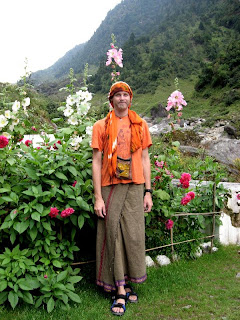

I practiced the "Christ walk" an old hippie had told me about in California. He said he'd met a guy in the Summer of Love whose "trip" was the "Christ walk"... it meant to walk barefoot, putting the toes down first, before letting the heal come down. Walking this way is easier on your joints, and allows you to sample a footstep before committing to it... useful in case of harsh ground. And the idea was that it gets you in touch with the Earth.. the Goddess... in some spiritualities. So I practised my Christ walk and remembered a chant from Rainbow Gatherings "Mother I feel you under my feet... Mother I feel your heart beat... Heya heya heya, ya haya haya ho, haya haya haya ha-ya ho!"... and no, this doesn't mean stepping on your biological Mother! It's about the Earth Mother! It felt good and got me in touch with the Reiki/earth energies. It slowed me down. It allowed me to enjoy each step and look around. I felt myself flow into a meditative bliss. I beamed and glowed.

"First be natural. Then you will be flowing in the river of the natural. And one day the river will fall into the ocean of the supernatural." -- Osho
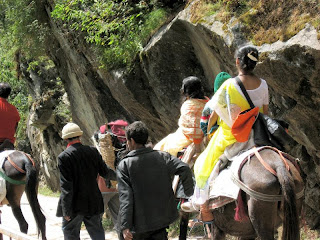

Hindu pilgrims walked or rode on ponies, dandi's, or bandi's. Kedarnath is one of four holy temple sites in the region, and is related to the story of Shiva and his transformation into a bull. Various body parts went to different regions. His lingam to Varanasi. His rump in Kedarnath. Etc. Kedarnath is also one of the water sources of the Ganga. Visiting these sites is supposed to remove one's karma/sins and allow one to die in relative peace removed from the cycle of reincarnations.

The route was hard enough. It's 14 km (8.7 miles) and a 1601 m (5252 ft) rise from 1982 m (6503 ft) in GauriKund to 3583 m (11,755 ft) at Kedarnath. Most pilgrims do the trip in one day up, and one day back. Many are not in any kind of condition for such a climb. Yet instead of being sensible and taking an overnight break at Rambara, which would be easier for their legs and lungs (acclimatization), they push themselves very hard. It seemed the same for Babadham, the 105 km barefoot pilgrimage I did in Bihar/Jarkhund in the summer. So here, all ages and shaped pushed upward at a hellish rate to reach heaven! The aged, infirm, and "lazy" hired ponies to ride, or bandi's... a large basket that a porter carried suspended from his head, or dandi's... chairs on rungs carried on the shoulders of four porters.

Most of the pilgrims looked miserable. It appeared like a penance. Being out of shape and walking at such a rate would be miserable. I concluded that riding on a pony, or other conveyance would likely be worse. One poor lady got off a pony and walked bowlegged in pain over to a bench. And as the weather cooled with higher elevations, I thought the riders must be even more miserable. Meanwhile I sang, enjoyed the view, and took my time. I was comfortable in a single layer and barefoot... the exercise generating plenty of body heat. I was in no hurry and enjoying the views. I put my sandals back on when my feet began to get sore. I thought it odd that no one else thought to make the trek a fun and enjoyable journey. But then I wasn't out to focus on my sins!

I was having the time of my life, traipsing along one careful barefoot step at a time. Feeling the energy of the Earth.. the natural church. Soon, as is often the case in India, my solitary pleasures were disrupted by a young man from Haridwar. Shod, he was walking faster. I let myself be drawn into his company. His goal was to be a champion body builder in five years. I dismayed at the thought... he was beautiful as he was, I thought. His English was only slightly better than my Hindi, and I misunderstood that he planned to stay in Rambara where I wished to stay. After meandering a hour past Rambara... I kept thinking we would reach the guesthouse where he planned to stay with his family... I found out that he planned to go all the way to Kedarnath. So I left him and retreated to Rambara where there was a delightful dormitory of clean white sheeted beds next to the river.

I was the only guest and looking forward to some quiet time and reading. I was just settling into bed when someone barged in the room looking for the manager. A family of four was caught in the rain... soaked and cold. The manager and staff were no where to be found... later it turns out they were off watching a cricket match on TV. I told the family what I knew of the rates and suggested they just move into the dorm. They did. I feel asleep to be awakened by the son who wanted to know if I knew how to give injections. No, I groggily replied. I looked over to see the middle aged man sitting up in bed on oxygen. His daughter intently sitting with him. I went to the bathroom and peed, and groggily returned to my bed. Finally, I inquired what was going on? I suggested if it was merely altitude sickness, that a simple retreat down the mountain would cure it. The daughter said that her father was suffering from kidney disease and his lungs were full of congestion. They had apparently anticipated such things and had some vein-injectable medicine for him. But no expertise in needling. I offered Reiki and went and gave the man some Reiki which he said was helping. Then someone walked in with a "doctor".. a young man who smelled of alcohol. He did seem to be knowledgeable about injections and medicine though. Unfortunately, the sick man had "no veins". After an hour and a half of unsuccessfully jabbing the man with a needle, the doctor gave up. I held my headlamp over them the whole time, and the son tried to help find the veins. I nearly grabbed the syringe and tried my intuitive luck, frustrated at the doctor's attempts. I was rather glad though that I didn't try my first injection on this difficult case. He had been imploring me to try before the doctor showed up.

I did some more Reiki on the man after the Doctor left and gave him the large Bethlehem Grid Crystal I was carrying to hold and sleep with... he seemed to be enjoying it. I asked if the family would retreat in the morning. No, they said... they would perservere and take a helicopter from the top! Crazy, I thought! Enough faith to get killed, but no enough to get cured! As I went to sleep, I had the intuitive thought that the man was dying of dehydration. In the morning I suggested water only to be told that that is the worst thing for a kidney patient! Here is someone whose kidneys are clogged and need to be flushed out. Meanwhile he is likely on heavy medications that are clogging and killing the kidneys. And so he is told not to drink water. Instead, drinks a few thimblefuls of tea or coffee... which likely only contribute to the problem. And certainly contribute to dehydration. A death sentence, I thought to myself. Then I prayed that I was wrong and that somehow he would survive in good health! No need for my judgements to affect him in the quantum consciousness of reality. I gave him the crystal after breaking of a few small pieces for offerings in my journeys.

In the morning I chanted by the river, then set off for Kedarnath. After the sun and my walking warmed me up a bit, I slipped off my sandals to savour the trek. I thought I'd waited long enough so the pavement would be dry from the previous night's rain... and I thought I'd gotten past the places where goat herds had soiled the pavement. I rounded a corner of the switchbacked trail to find the stone path speckled in goat droppings. I laughed at my attempt for cleanliness, and pressed on. I thought of my Grandma Emma and her tales of walking barefoot through the barnyard and enjoying it! I embraced my heritage! A bit reluctantly, but I embraced it!

I hummed, chanted, and sang enjoying the scenery. I passed, and was passed by the family with the kidney patient. I hailed "Jai Kedar!" to them with a broad smile each time I passed one of them. That is the chant of this pilgrimage to cheer your sister/brother pilgrims on. The whole family was riding in dandi's.
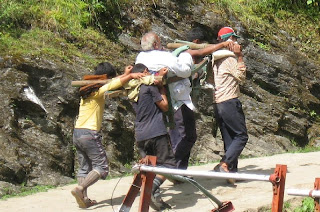
Soon, my enjoyable solitude was intruded upon by a Nepali man. He kept demanding to help carry my backpack, to which I refused. In part, I didn't want to feel colonial; in part, I was quite happy carrying it and strengthening myself; and in part, I wondered if it wasn't a ploy for money. I was soon missing my solitude and singing to myself. I wondered how I might nicely part from him. Luckily a group of porters carrying a dandi passed and said something to him... it seemed that maybe he had some work to do and he ran off! I rejoiced in my solitude again.

Eventually I reached the bowl of land holding Kedarnath, surrounded by mountains on three sides... like an open flower. I could see some peaks in spite of the clouds. The path was flat now, and ponies and pilgrims trudged into the center. On the outskirts of the small town surrounding the temple, I passed a row of dhabas serving food. Fresh mustard greens caught my eye and I ordered a thali... a plate of rice with dahl (lentils) and sabji (vegetables... in this case cooked mustard greens)... and I enjoyed one of my favorite greens!
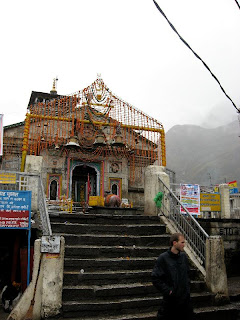
Then I proceeded into to town only to be overwhelmed by the chaos of a tourist center surrounding the temple. At 3583 m, no one lives here year round, except maybe a couple of priests. The town is merely for the tourists. Numerous priests hawked the route to sell puja's (rituals). Several tried to latch on to me as I walked through the town. I shed them. But at the temple I grew fearful. Could I just go in? Was it required to have a priest and puja? I sat and meditated on a stone wall. A doctor from the nearby clinic chatted me up. He turned out to be genuine and nice. He said I didn't need a priest... that I could just go in the temple.

The chaotic civilization scattered my mind. Maybe the altitude too. It took me a while to figure out what nearby sites I wanted to visit. Then I got "lost" for a bit from directions in pigeon English. After a failed attempt at the shortcut path to Ghandi Tal, the glacial lake where Gandhi's ashes were spread, I finally got on the right route. Unfortunately, I was quoted a time of two hours, and I wanted to return to Rambara. The day was running short. But I decided to try to make it to Ghandhi Tal.
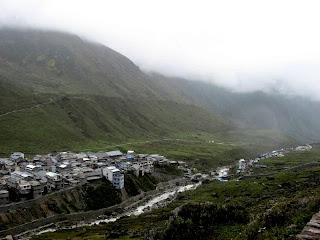
I clipped along up the rough path, higher above the already high Kedarnath. I practically ran. Rain started falling. I began to get wet and stopped to change from lungi to windpants and rainjacket. I debated turning back. But a group of young Indian men trudged past. So I decided to follow them. A couple of them were good at eeking out the shortcuts between the switchbacks. I was glad I perservered because in a few minutes we reached the lake. It lay about 30 feet below the path in a cloud bank. Moss green shown through from the rocks below the clear water. It was beautiful. I didn't dare photograph it in the thick rain/sleet for fear of my camera getting too wet. I made some prayers and tossed a piece of Bethlehem grid crystal into the beautiful abyss.
I barely finished my prayers and chants when a plastic covered figure came out of the mist. A monk from Bangledesh who had trekked over the glaciers from Gangotri greeted me. I glanced down to the ground and picked up a small stone that "spoke" to me, putting it my pocket. I continued with my "work" to visit a cairn that lay above me on glacial til. Not much to see there, I returned to find the monk waiting for me. I wondered where his guide and/or companions were. I learned he wanted to join me in the descent. I was a bit dismayed as I was happy alone, and was now bent on running down the mountain so I could get on to my other trekking destinations.

We made our way down to Kedarnath, where I visited the Temple and he continued downwards. The temple was anticlimatic. I managed to get through it with out buying a puja (ceremony) from the many priests. I then started jogging down the mountain. I was drenched. I was cold. I didn't fancy the clustered village of Kedarnath. And I was ready to head out to Hemkund the next day. Even in my jogging, I was passed by Nepali porters carrying the dandi's (chairs with passengers). I marveled at their synchronized steps and endurance. They jogged down the road with their loads. They seemed to dodge the raindrops while their passengers grew wet and cold. I marveled at their seeming comfort in simple cotton clothes that seemed to shed rain while I grew colder and wetter under my poly base layer and raincoat.

Just above Rambara I ran into my glacier trekking monk friend. I wasn't sure I wanted to end my solitude. We trod down into Rambara together. The rain kept us wet and cold while the lower elevation took a bit of the edge off the chill. In my mind, I mulled over the idea of staying in Rambara, but decided I wanted to head to Garikund so I could leave for Hemkund the next day. About 100 m past the guesthouse I'd stayed at in Rambara, I felt a twinge of pain in my left knee. Stupidly, I thought it silly to return up hill. Surely I'd cruise on down to Garikund in no time. Aches continued to spread through both legs with each of the 8 km. The monk tried to talk with me but my misery kept me removed. He shared some glucose powder with me, which I mixed with water. I began to realize I hadn't taken the best care of myself. Water and food I knew would go along way to rejuvenating me. I tried to drink more water. I felt a lack of time, in wanting to get to Garikund by dark.

We trudged onwards down the cobbled trail, stepping aside as ponies with cold wet riders clipped past us, sometimes nearly running us down. The monk went into a spontaneous spiel on the wonders of meditation and how if you meditate into pain it will go away. My ego made me feel talked down to... I knew all that from a Reiki perspective and wasn't sure I needed the free advertisement! Nonetheless, I tried to heed the advice... I don't think he realized how much pain I was in. I tried to meditate the pain away. Well, as well as one can when they are trekking down a mountain in cold wet rain. About as hard and fun as trying to do a sitting meditation in a room of mosquitoes! A few minutes later I grumbled to the monk that I was trying and the meditation thing wasn't working! He acknowledged the difficulty that we all face. He acknowledged his own challenges.

We trudged on through the rain and mud. I stepped off to pee a few times to let out all the water I was drinking in hopes of lubricating my knees. At one point, he asked if I wanted to stay with him in the ashram; he'd have to check with the manager of course. I never gave him a direct answer. The truth was I wasn't sure if it would be nurturing. Perhaps it would be better for me to take care of myself. Finally, he asked if I was going to answer his offer. I said I wanted to see how things went. He didn't know where the ashram was. I didn't want to walk any further than I had to.

About an hour after dark we finally reached Garikund. A hotelier asked me if I wanted a room as I went by... how much I asked? 100rs he replied. I was going to check it out, but the monk was upset that I wasn't going on to the ashram. He said it was near. I hobbled along like a spent race horse. The pain was unbearable as it had been for nearly 2 hours. We reached the ashram which was down by the hot spring. The manager did not permit me to stay. He told me to follow a boy, who led me to the hotel next door. The hotel didn't thrill me a bit. The manager led me all the way up the stairs to the fourth floor. I gimped up the stairs. He showed me the room. Grimy green walls and musty odor didn't impress me. He said it was 250rs. I told him I'd seen another for 100rs. He was shocked when I started following him back out. "Don't you want the room?" I said why should I pay 250rs for a room when I can get one for 100rs! He finally relented to 150rs. My legs were aching so much, I took it, top floor and all.

I gimped down to the hot springs 50 m around the corner, and found the "pool" emptied for cleaning. Uggh. I returned to my room for a cold bucket shower. I went for food. I risked ordering palak paneer (spinach cheese curry) from a priceless menu, thinking I'd treat myself to a favorite dish. It wasn't so good. Then I was charged 90rs which seemed outrageous. My feet hurt from rubbing on my sandal straps. My legs ached. I lay in bed. I went to a pharmacist for Tiger Balm. All he had was some chemical heating lotion. Not even anything like Ben Gay. I got some Vitamins C and B. He said I'd be fine after a day of rest. I wasn't so sure.

Miserable. I lay in bed. I yearned for home. "I want to go home!", I moaned to myself. A typical response to sickness in a foreign land. I tried to imagine home Images of the US flashed through my mind... my last domicile in San Francisco, my parents house, my Aunt and Uncle's house. But I couldn't really imagine going back and creating a home, setting up housekeeping, etc. And later sitting in the steaming waters of the public bath, a stone adorned tank similar to a swimming pool, I began to appreciate where I was. In India. In a public hot pool. Surrounded by men (women have a separate pool). It was comforting. And I began to see my confusion.

I want to go home. But where is my home? Fond images from all over the world popped into my head. Steamy saunas of Thailand, and the familiar streets of Chiang Mai and Bangkok with their marvelous street food. The foggy hills of San Francisco and my faerie friends there. The stone lined streets of Thamel, Kathmandu, Nepal, and the little disco that calls itself the Funky Buddha Bar. The hills of the Butternut Valley where my father grew up in upstate New York. The Clay Hotel Hostel and Washington Street in South Beach, Miami. The glowing energy of Joshua Tree in California. And my beloved Mauna Loa in Hawaii. The friendly people of Laos and tubing in Vang Viang.

I realized I have no place to call home anymore. My sense of place is shattered. I'm truly homeless. I've virtually shattered my identity. The only thing left to do is to be at home wherever I am. The only thing left to do is to be present with who I am in the moment.

I felt empty. I felt pain. I lay in my bed depressed. The pain and injury didn't fit into my plans. The balm from the pharmacist didn't seem to work. I was miserable. In 36 hours I'd gone from discovered my greatest joy... traipsing up the mountain... to loosing it. To top things off, I felt a cold coming on.

Then I picked up the stone I'd found by Ghandi Tal (the lake above Kedarnath). I felt the vibration and energy of the stone permeate my body. I grew excited. The "other" reality. The Reality of Reiki and metaphysics and energy healing was back! I thought to myself how years ago after getting into Reiki I had learned to disown the reality of having/catching colds. I had started viewing them as detox symptoms from my body clearing toxins. Why, that made sense now after my first big exercise in a month. Further I remembered how several years ago I had decided to quit having colds, and merely seen them as patterns of being that I could choose my way out of if I started to have symptoms. Then I realized my knees and legs were no different! Why was I projecting a self hypnotic future of not being able to continue on my treks? I started to remember my own magic. The power of empowerment I had shared with so many clients in my Reiki practice. I remembered how several years ago I would simply ask my body to release the pattern if I started to feel twinges of knee pain. And it would work. I remembered how one day riding my bike up a hill to work, I had felt a twinge of knee pain, and banished it off, saying "I don't have time for this now!"

I grew excited. I started setting intentions for healing for alignment. I started to envision myself going trekking at Hemkund. The next few days rained. I spent two days in that hotel room. I discovered the best sleep in months as the raging river made a beautiful melody that drifted in the bathroom window. I enjoyed dreamy sleeps that felt like streams of consciousness. Memories from my past bubbled through my minds eye as the rains bubbled through the hills. I felt the most relaxed I had in months. I felt good! I slept and napped and Reiki'd myself throughout the day. I found a dhaba that had the best all you can eat thali (only 35rs) ever! I ate there twice a day. The staff treated me like a king. In between I soaked in the hot sulphur waters of the public bath, enjoying the views of the other men. My pains indeed went away. And finally one evening I booked a ticket for the 6 am bus to Govindghat, the departure point for the Hemkund trek.

The magical monk from Bangladesh, who had popped out of the fogs at Ghandi Tal, I never saw again. I tried to find him the day after our descent, but he had left. I'll always wonder how he transversed the glaciers from Gangotri to Kedarnath, apparently alone in a lungi and a plastic raincoat. Like so many others we meet walking about the world, he flashed out of my life as quickly as he appeared.